Earth seen from orbit over the Andaman Sea and Southeast Asia at dusk, with glowing infrasound rings spreading from the coastline
Open-science institute · Phuket, Thailand

We are giving the planet a sense of hearing.

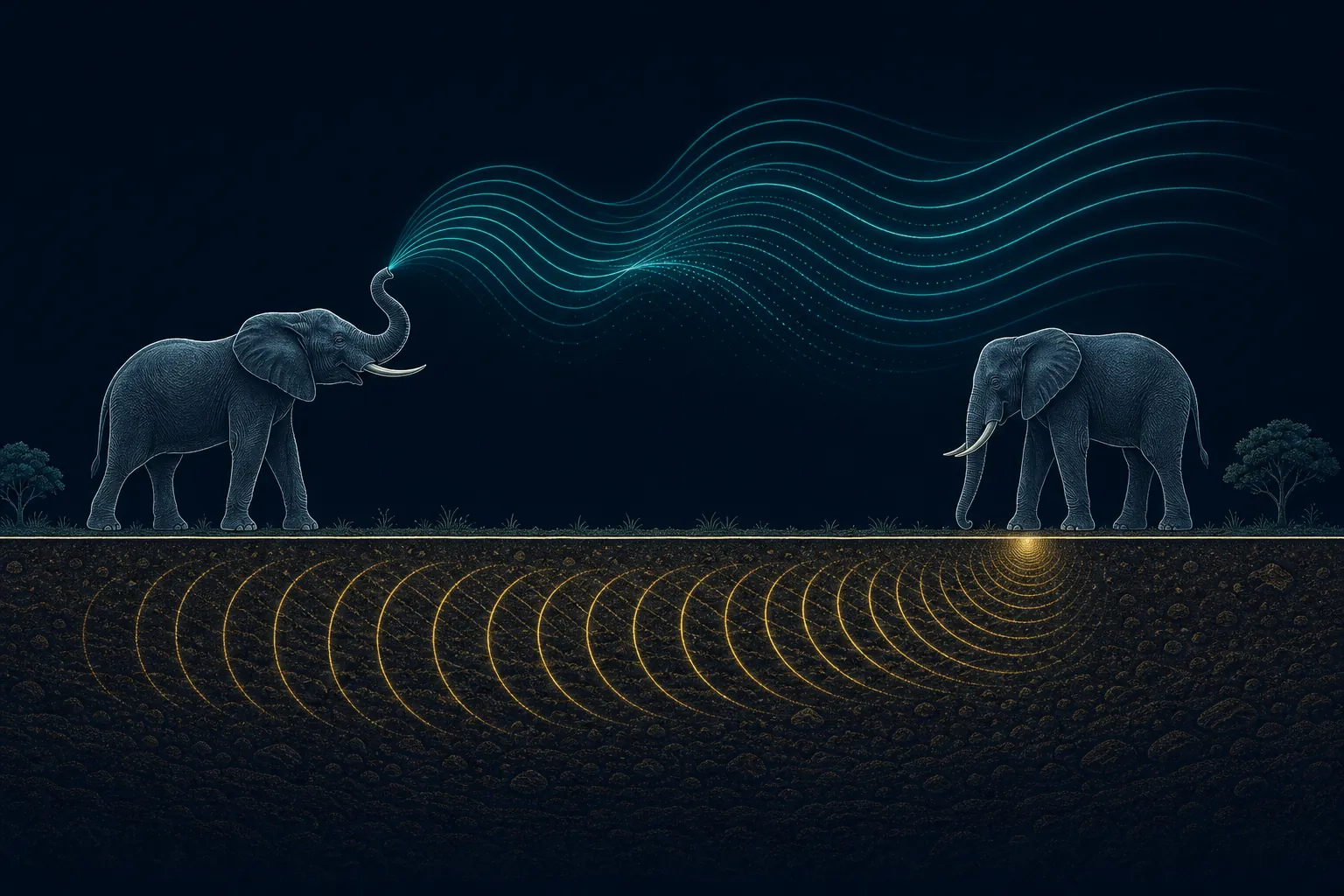
Long before a tsunami, an eruption or a jellyfish bloom reaches people, it sends out a sound too low for us to hear. Animals catch it and move — in 2004, elephants on this coast climbed to higher ground before the wave. We build cheap sensors and open data so a coastline can catch it too, in time to protect both lives and the infrastructure that sustains them.

Open data & open hardware 318 vetted science sources 1M+ impressions across YouTube, Instagram & Facebook

We hear what the elephants heard. Started in Phuket, Thailand, in memory of 26 December 2004.

Why we exist

Nature already has an early-warning system. We're building the receiver.

In 2004, elephants on the Andaman coast climbed to higher ground minutes before the wave came in. Birds clear out a day ahead of a big storm. What they're catching is infrasound: pressure waves under 20 Hz that carry for hundreds of kilometres. Scientists have measured it for decades. Hardly anyone is listening for it right at the coast, which is the one place a few minutes of warning changes the outcome.

That gap is our job. We make low-cost acoustic tools that help people hear trouble sooner — earlier warning for tsunamis and eruptions, protection for the coastal infrastructure life depends on (power-plant and desalination intakes, aquaculture), and a way to keep people and wild animals apart without nets, poison or harm. All of it is open, and we try to be plain about what already works and what we're still figuring out.

The longer view: as the network grows — cheap sensors spread densely, anchored by a few precise reference stations — HERD becomes an open platform for the whole research community. A place where scientists anywhere can develop and, just as important, reproduce and confirm new methods: signal-processing algorithms, machine-learning models, studies of atmospheric and geophysical processes, and new ways to catch dangerous events earlier. The instrument is a public good — and the discoveries made on it can be too.

Diagram: infrasound from a distant event propagating along the coast to sensor stations
Infrasound carries for hundreds of kilometres — the signal arrives long before the water.
Satellite view of the 2022 Tonga eruption pressure wave crossing the ocean
Tonga, 2022: the atmospheric pressure wave outran the tsunami by hours, and barometers worldwide caught it.
A low-cost HERD infrasound sensor node
Our answer: a $25 node, thousands of them, and a cloud that listens to the whole choir at once.
1M+impressions across YouTube, Instagram & Facebook
318vetted science sources
100%into R&D & the network

We keep the hardware, the data and the money out in the open. Every gift shows up in a public quarterly report.

Combined reach on YouTube, Instagram and Facebook, paid campaigns included. We'll confirm the exact number from platform analytics before the public launch.

Fifteen seconds

The whole idea, in one walk on the beach.

Fifteen seconds from the founder: what infrasound is, what we're building, and why it starts on this coast.

  • Infrasound — the deepest voice of the planet, and the signal everything here listens for.
  • Humane protection from venomous sea life, and early warning for tsunamis and volcanoes.
  • A small open lab in Phuket, working out in the open, all over the planet.

Made with AI video tools and said so out loud — same rule as everything else here: honest about what's real and what's a render.

What we work on

One lab, a few ways of listening.

Everything here points at the same goal: cheap, open tools that hear the planet and protect what it sustains — lives, coastlines and the infrastructure people depend on. We've marked where each one honestly stands today.

Exploratory · early What we're testing, and what we've dropped

Publishing the dead ends is part of doing this honestly. A wearable animal-repellent, for one, we looked into and dropped: the independent evidence for ultrasonic or infrasonic personal repellents doesn't hold up, and a device that small can't put out real infrasound anyway. Other early ideas we keep quiet until there's data solid enough to stand behind.

Open hardware

How a single node works, and why it's open.

We're not betting on one expensive, ultra-sensitive station. We're betting on thousands of cheap, ordinary ones. Each node is a simple barometric sensor held to precise GPS time, so the cloud can line them all up and compare.

  • Three small barometers on one board. Averaging them cancels each sensor's own noise. It's the cheapest way we know to hear a little better.
  • GPS timing. A once-a-second pulse holds every node to within a microsecond of UTC, so stations hundreds of kilometres apart can be lined up.
  • The device decides nothing. On its own, one node can't tell a tsunami from a slammed door. A real event turns up on many stations at once along the coast. The network is the instrument, not the box.
  • The judgement happens in the cloud. A neural network learns to drop wind and hum and to label the real events across the whole array.

We publish the schematics, firmware and data as we go, so anyone can check our work, build their own, or improve ours. The full build lives on the flagship device page ↗.

Exploded schematic of an infrasound sensor node: solar panel, GPS antenna, weatherproof enclosure, barometer and data module
Illustrative schematic. The labels and numbers are a rough concept drawing, not our official spec; the real build spec lives on the flagship device page.

In the field
A researcher checking a solar-powered coastal sensor node at dawn
Illustrative. The first HERD node isn't finished; this is the kind of fieldwork it takes to get there.

An open lab, out on the coast.

We're a small team, working on the same coast the sensors are meant to protect. Prototypes get tested in the weather they'll actually sit in, checked against proper reference instruments, and written up in the open.

  • Outside, not on a bench. We measure the wind and the noise where a node will really stand.
  • Honest calibration. Prototypes run next to reference microbarometers, so we know their real limits, not the ones on the datasheet.
  • Open notebook. The data, the lab notes and the failures all go out. The whole point is that someone else can check them.
Our principles

Principles we won't trade away.

Open by default

We publish the schematics, data and lab notes as we go. If someone can check it, copy it or improve it, we've done the job right.

Honest science

When something is an experiment, we call it one. No promises of a certified alarm, no miracle claims, and the results that don't work get published too.

Humane technology

We want people and wild animals to stay out of each other's way, without hurting the animals. Steer them off, don't destroy them.

Citizen-first

The network belongs to the people who host it: cheap devices, money kept in plain sight, and data that serves the coast it came from.

Start reading

Start with the library.

363 checked sources across 13 topics. New to this? Try one of these six first.

All 13 topics & 363 sources →
How to support

Ways to help pay for the work.

HERD is run by HERD Network, LLC, a small for-profit research company rather than a charity. We'd rather say so plainly. Here are the real ways money reaches the work, and what each one actually does.

Individuals

Donate any amount

A one-off card payment. It covers parts, field trials and open data across everything we do. No equity, no refund once it's spent, and it isn't a tax-deductible charitable gift.

Donate →
Companies & CSR

Sponsor a program

Back one program and get something concrete in return: your logo, named stations, and a CSR report your finance team can usually file as a marketing or CSR cost. Bronze, Silver and Gold tiers, or a custom R&D package.

Support & partner →
Grants & patrons

Back the mission

For foundations, science patrons and public programs: grants, a named research centre, and a fiscal-sponsor route for tax-deductible gifts (through Open Collective, which we're setting up now). Tell us what you need and we'll build it around that.

Talk to us →

The honest version: money given straight to HERD Network, LLC is not a tax-deductible charitable donation. A company sponsorship with deliverables usually counts as an ordinary marketing or CSR expense (check with your accountant). For gifts that have to be tax-deductible, we're setting up a fiscal sponsor, a 501(c)(3) host through Open Collective. Ask us where that stands, or see the full list on the Support page.

Get in touch

Talk to us.

Grants, sponsorship, a research collaboration, or just a question — send a note and we'll write back. No newsletter, no sales list.

or email [email protected]
Who is behind this

A small team in Phuket, in memory of December 26, 2004.

HERD Research is run by Artem Podelenko from Bang Tao, Phuket — the stretch of coast that learned the hard way what ten minutes are worth. The team is small on purpose for now: Artem, a lot of AI tooling, and a hardware engineer on contract here in Phuket. We're not going to fill this page with stock-photo scientists we don't have.

We work with researchers, hotels, developers and people who just live here. If your work touches infrasound, bioacoustics, marine biology or disaster prep, get in touch.

Partnerships & research: [email protected]
Questions

Straight answers.

What is HERD Research?
It's the umbrella over everything we do. theherd.network is the main project, the infrasound early-warning network. Under the same roof sit the open infrasound library, the jellyfish program, and our early bioacoustics research.
Is HERD a charity? Are donations tax-deductible?
No. HERD Network, LLC is a for-profit research company, so a gift straight to us isn't a tax-deductible charitable donation. A company sponsorship with deliverables usually counts as a marketing or CSR expense instead (check with your accountant). For genuinely tax-deductible giving, we're setting up a fiscal sponsor: a 501(c)(3) host through Open Collective.
Can your $25 sensor detect a tsunami by itself?
Honestly, not on its own — and we don't pretend one cheap node is a tsunami alarm. Our design is two complementary layers. Layer 1 is a dense grid of $25 nodes that hears source-event infrasound — earthquakes at ~0.02–5 Hz, eruptions, and atmospheric Lamb waves (the same signal that outran the 2022 Tonga tsunami by hours): breadth and the earliest source alert. Layer 2 is a small number of research-grade microbarometer anchor stations that catch the tsunami wave signal itself in the sub-0.01 Hz band cheap MEMS cannot reach. Each layer covers the other's blind spot — early and comprehensive. Still a complement to official warning systems, not a certified siren.
Is the sensor built yet?
The first cheap node (Proto-1) is in final assembly right now — not shipping yet. We'd rather say that plainly than pretend it's already in the field.
What are the "exploratory" directions?
Questions we look into in the open before committing to them. Some don't make it: the wearable animal-repellent, for one, we studied and dropped because the independent evidence wasn't there. We publish those too.
How can I help or partner?
Give any amount, sponsor a program as a company, bring a grant, or work with us on the science. Email [email protected].