Sailors have long noticed jellyfish moving away from shore before bad weather. That is not necessarily weather forecasting — but jellyfish have balance organs, and storms create very low sound waves that travel far through water. Put biology, physics, and real intake failures together and you get a story you can test.
Ten sections below, from simple to detailed. We explain unfamiliar terms the first time they appear and label open questions as hypotheses. At the end: the full bibliography with search.
Watch: Jellyfish Acoustics
A short HERD film: how jellyfish sense low-frequency sound, why blooms hit resorts and intakes, and what a gentle acoustic corridor could mean. The full wiki continues below.
How a jellyfish senses water
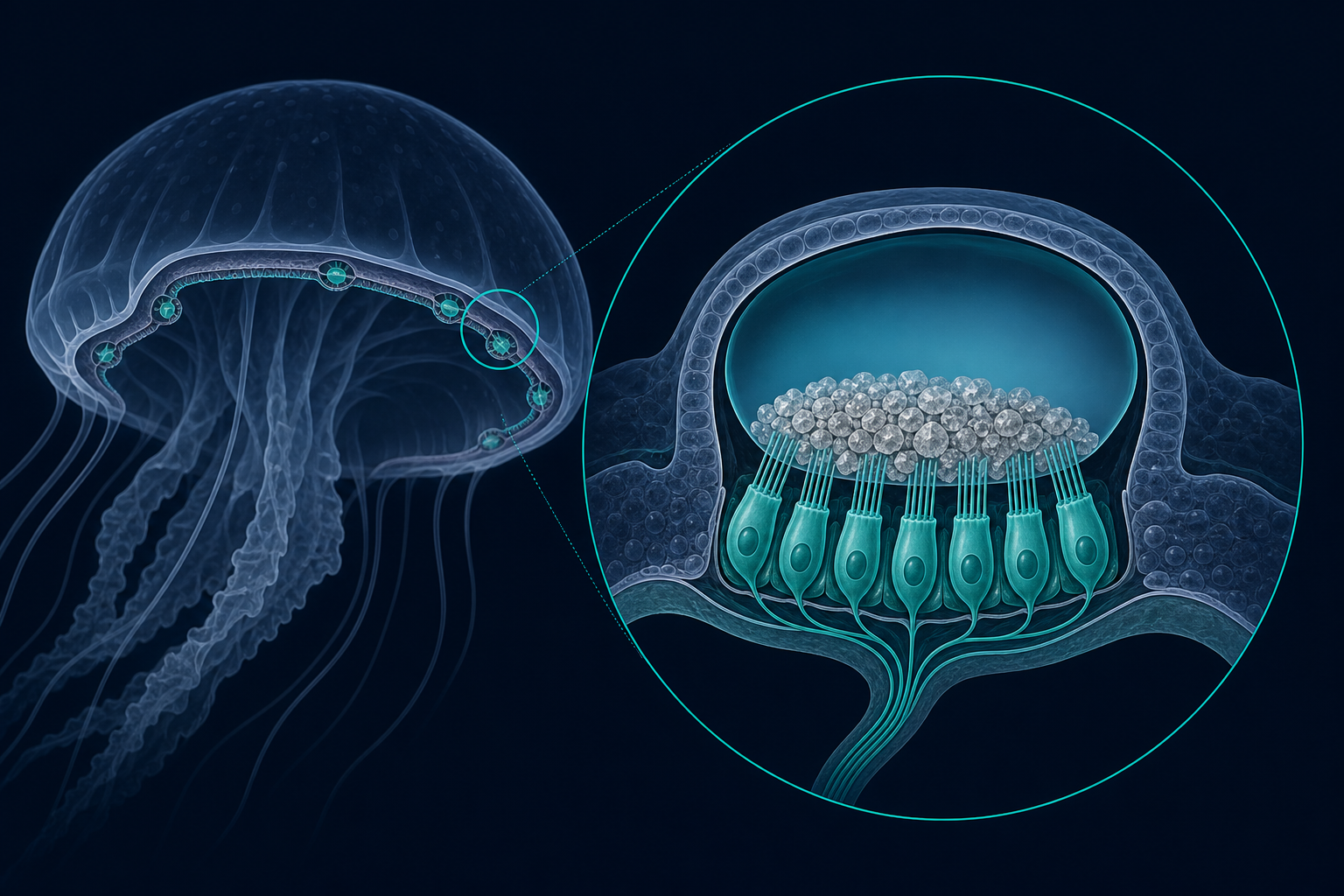
Around the bell margin, jellyfish have tiny balance organs called statocysts — sometimes described as an “ear without a brain.” Inside are mineral grains and hair-like sensors that respond to tilt, current, and bumps in the water.
A physics detail that matters: those hairs respond not to “loudness” (pressure) but to the motion of the water particles themselves — to oscillatory acceleration. Fish have a swim bladder that converts pressure into motion; a jellyfish has none, so quoting its threshold in the usual “pressure decibels” is the wrong unit.
Storms, low sound, and moving offshore
Storm fronts create infrasound — sound below what humans usually hear — that can travel tens of kilometers through air and water. People often feel it as pressure or a deep rumble, not ordinary noise.
What has been measured in the lab: loud sound in the 50–400 Hz band damages exactly those statocyst hair cells (Solé et al., 2016 — 157 dB re 1 µPa, 2 hours). So the tissue is clearly not indifferent to sound. What that study did not measure is behaviour: nobody watched whether the animal swam away. And separately: no controlled infrasound (below 20 Hz) experiment on jellyfish exists — 50–400 Hz is not infrasound. That they “leave in time” ahead of a storm remains a hypothesis to be checked coast by coast.
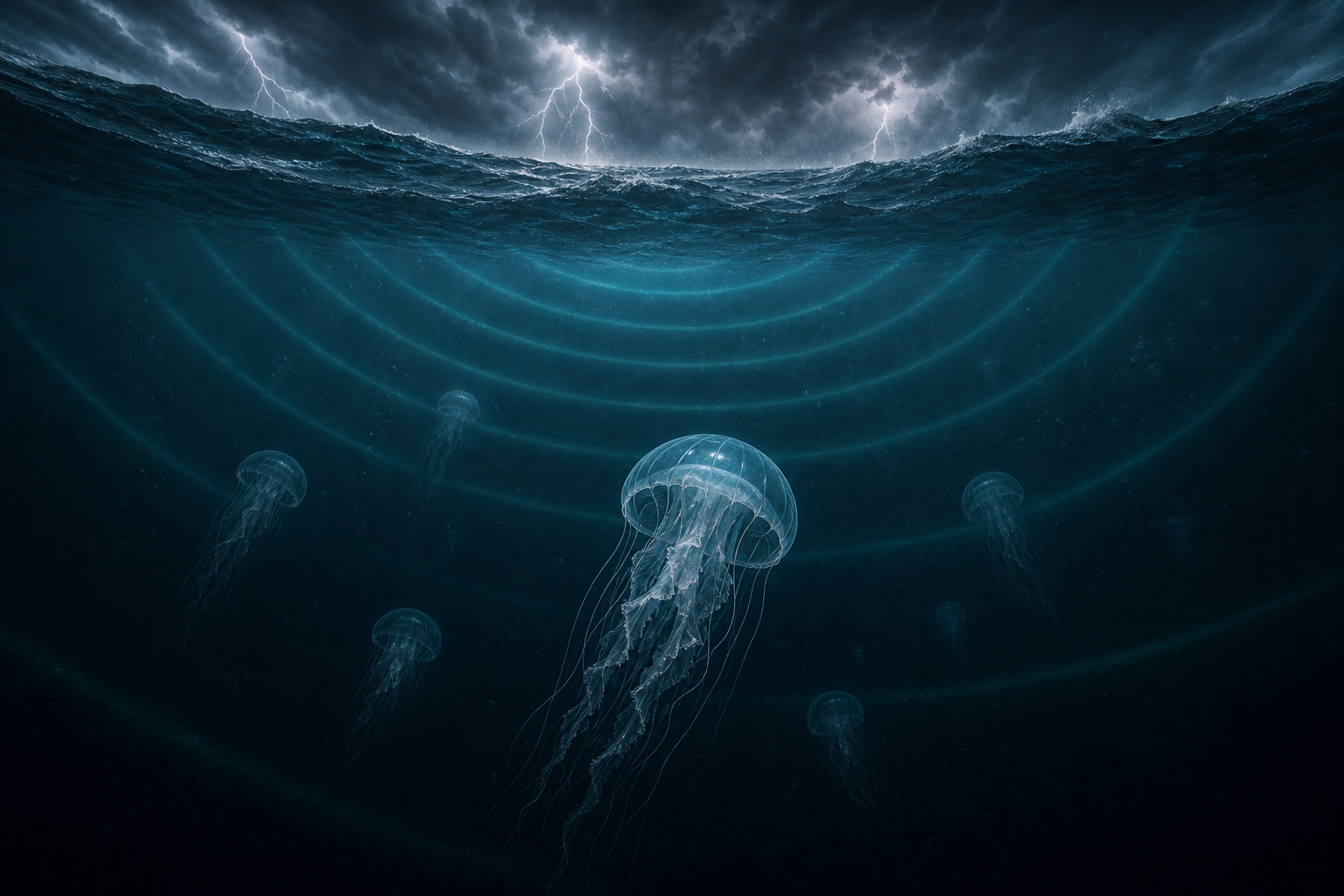
We separate checked facts from working guesses — clearer for readers and fairer for science.
Mass swarms around the world
Jellyfish blooms — sudden masses of millions of animals — do not rise everywhere at the same rate. But in many seas they repeat more often when warming, nutrient pollution, overfishing, and coastal change overlap.
For resorts and power operators the practical question is simpler: does it happen again and again at your intake, season after season?
- Jellyfish are ancient and resilient across mass extinctions.
- Dense swarms can disrupt cooling-water systems within hours.
- Impacts span tourism, fisheries, desalination, and energy.
Map of risky coasts
Below are 18 planetary regions where jellyfish swarms keep coming back. Priority A: Andaman, Japan, Israel, northern Australia, Mexico; B: Brazil, Caribbean, Mediterranean; C: historical and watch zones.

| Region | Tier | Typical species | Impact |
|---|---|---|---|
| Andaman: Phuket / Krabi / Phang Nga (TH) | Tier A (high) | Aurelia, cubozoa | Tourism, hotels, desal, marinas |
| Gulf of Thailand (Samui, Pattaya) | Tier A (high) | Aurelia, Rhizostoma | Beaches, mariculture |
| East Coast TH (Rayong-Trat) | Tier A (high) | Aurelia | Industrial cooling water |
| Seto Inland Sea / Osaka Bay (JP) | Tier A (high) | Nemopilema nomurai | Fisheries, intakes |
| Sea of Japan (Fukui, Shimane) | Tier A (high) | Nemopilema, Aurelia | Nuclear intake incidents |
| Yellow / East China Sea (CN, KR) | Tier B (medium) | Nemopilema, Cyanea | Large blooms, energy risk |
| Western Mediterranean (ES, FR, IT) | Tier B (medium) | Rhizostoma, Pelagia noctiluca | Tourism, fisheries |
| Adriatic coast | Tier B (medium) | Rhizostoma | Marinas, beaches |
| Israel Med coast (Ashkelon, Hadera desal) | Tier A (high) | Rhopilema nomadica, Aurelia | Desal intakes, water security |
| North Australia (QLD, NT, WA — stinger coast) | Tier A (high) | Chironex fleckeri, Irukandji | Box jellyfish, yachting, stinger season |
| US Gulf / East Coast | Tier C (watch) | Sea nettle, Mnemiopsis | Fisheries, plant operation |
| Black Sea / Sea of Azov | Tier C (watch) | Mnemiopsis leidyi | Historical ecosystem collapse |
| Irish Sea / UK west | Tier C (watch) | Various species | Tourism and pilot monitoring |
| Malta / Eastern Med islands | Tier C (watch) | Rhizostoma | Desal + tourism |
| West Africa (Benguela) | Tier C (watch) | Large scyphozoans | Fisheries pressure |
| Mexico Gulf & Yucatán (Veracruz, Cancún, Campeche) | Tier A (high) | Aurelia, Tamoya, Stomolophus | Tourism, PEMEX cooling, cruises |
| Brazil SE coast (Santos, Rio, São Paulo state) | Tier B (medium) | Lychnorhiza, Olindias, Aurelia | Beaches, Angra nuclear, fisheries |
| Caribbean (Cuba, Jamaica, Puerto Rico, Dominican Rep.) | Tier B (medium) | Aurelia, Cassiopea, cubozoa | Tourism, cruise ports, island desal |
The Mediterranean coast is one of the world's most desal-dependent regions. Summer swarms of Rhopilema nomadica and Aurelia have repeatedly clogged seawater intakes at plants such as Ashkelon and Hadera. The 2019 event shut water supply for hours. For a water-stressed country this is not a beach nuisance — it is water and energy security. Tier A for HERD utility pilots.
Queensland, the Northern Territory and WA are home to Chironex fleckeri and the tiny but deadly Irukandji. Stinger season closes the water for half the year; nets and stinger suits are standard. The coastline runs for thousands of kilometres — premium yachting, resorts, guest safety in wild tropical bays. A humane LF barrier is both a medical and commercial case — jellyfish R&D.
Veracruz, Cancún and Campeche — Aurelia, Tamoya and egg-yolk Stomolophus: beaches, PEMEX cooling and cruises. HERD LATAM starts here — Popocatépetl pilot plus coasts where blooms hit tourism and infrastructure.
Summer blooms of Lychnorhiza and Olindias close São Paulo and Rio beaches. Nearby: Angra nuclear and one of Latin America's busiest ports. Monitoring plus gentle acoustics is a natural pilot for resorts and utilities.
Cuba, Jamaica, Puerto Rico, Dominican Republic — Aurelia, upside-down Cassiopea and cubomedusa at busy beaches. Cruise ports and island desalination turn blooms into infrastructure risk, not exotic sea life.
Power plants and seawater intakes
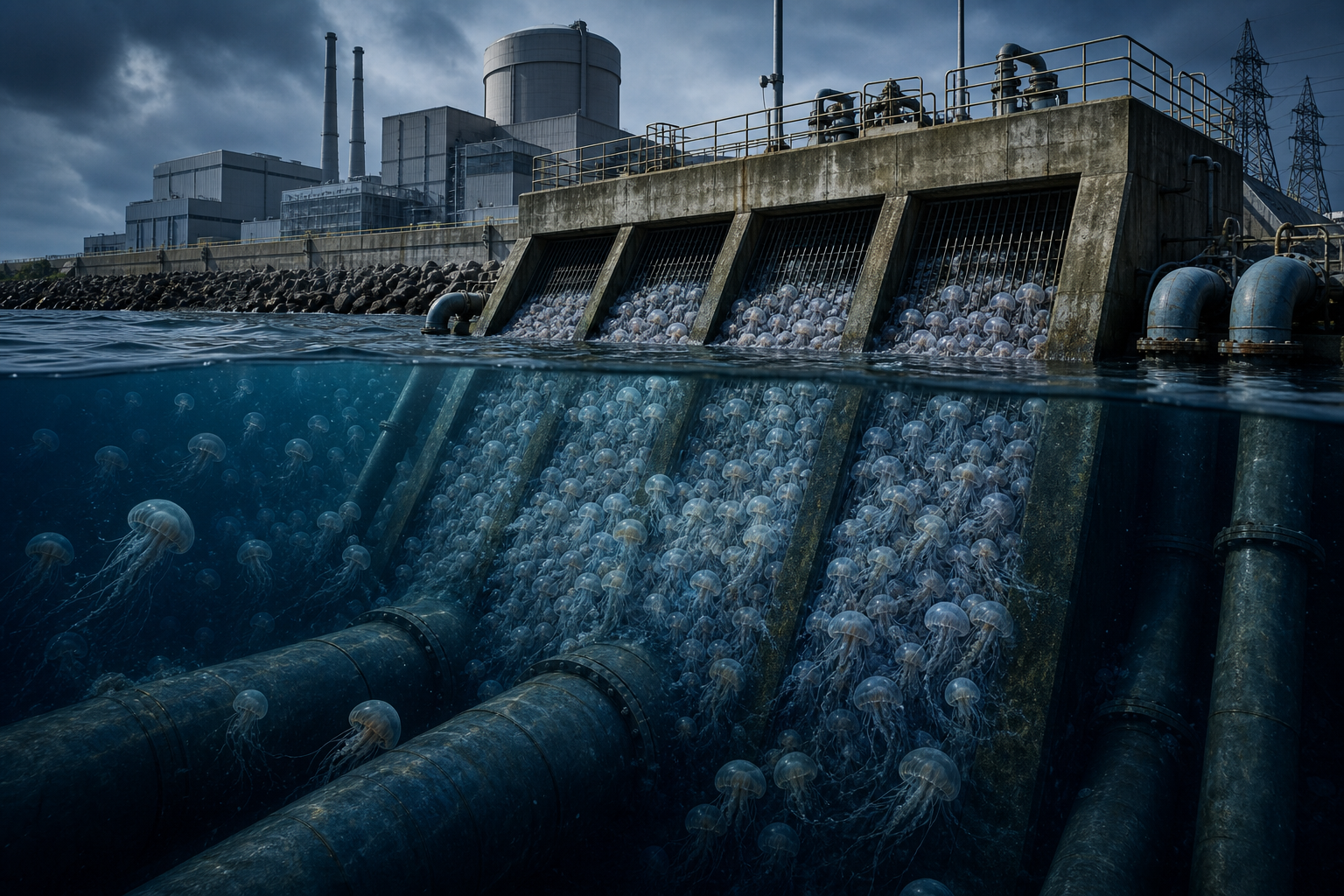
Coastal nuclear and thermal plants and desalination plants pump millions of liters through screens and filters. A dense jellyfish swarm can clog them within hours — throughput drops and shutdown risk rises.
That has happened in Japan, the UK, Sweden, Israel, and northern Australia — from nuclear intakes to beach closures in stinger season.
| Year | Site | Country | Consequence |
|---|---|---|---|
| 2011 | Shimane Nuclear PP | Japan | Cooling-water restriction |
| 2011 | Torness Nuclear PP | UK | Temporary shutdown |
| 2013 | Oskarshamn Nuclear PP | Sweden | Major reactor stop |
| 2019 | Desalination plant | Israel | Intake clogging |
| 2021 | Torness | UK | Repeat jellyfish event |
| 2023 | Northern beaches (QLD/NT) | Australia | Beach closures, stinger season |
| 2024-2025 | Multiple coastal plants | China | Regional bloom pressure |
| 2025 | Gravelines Nuclear PP | France | Four units shut down |
Key species
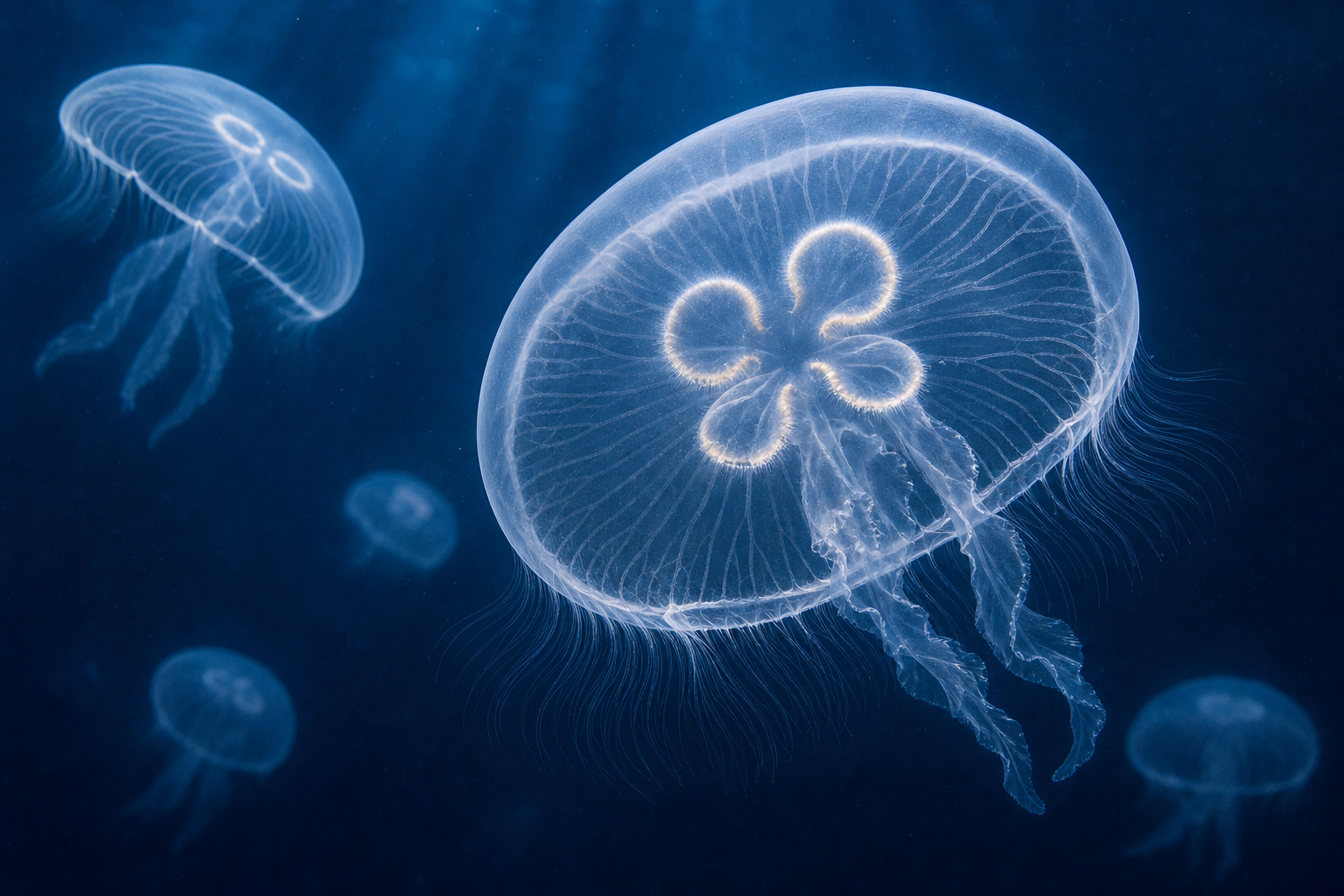
Mass swarms — reputational and infrastructure damage at beaches and intakes.
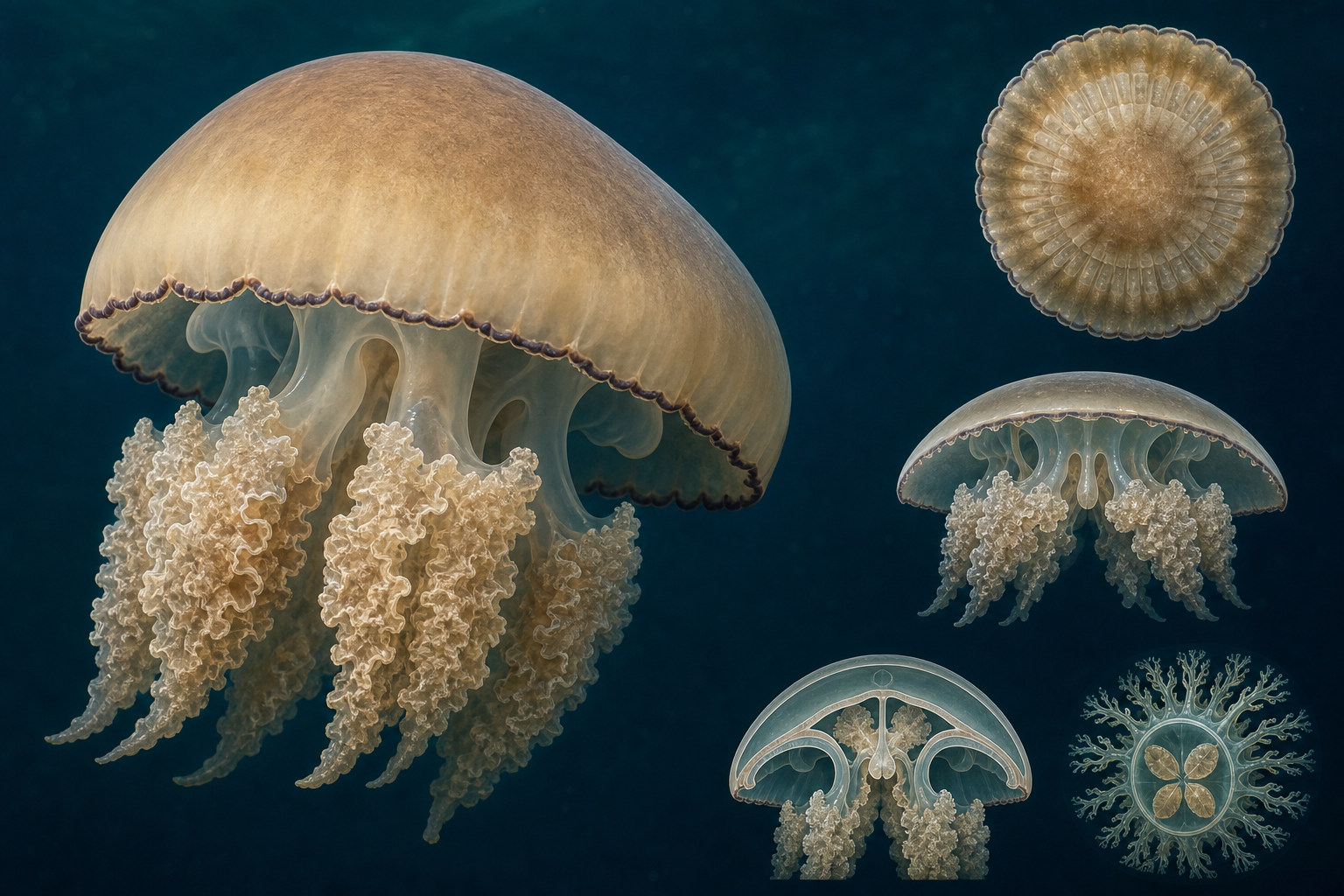
Typical Mediterranean bloom species — large barrel jellies near resorts.
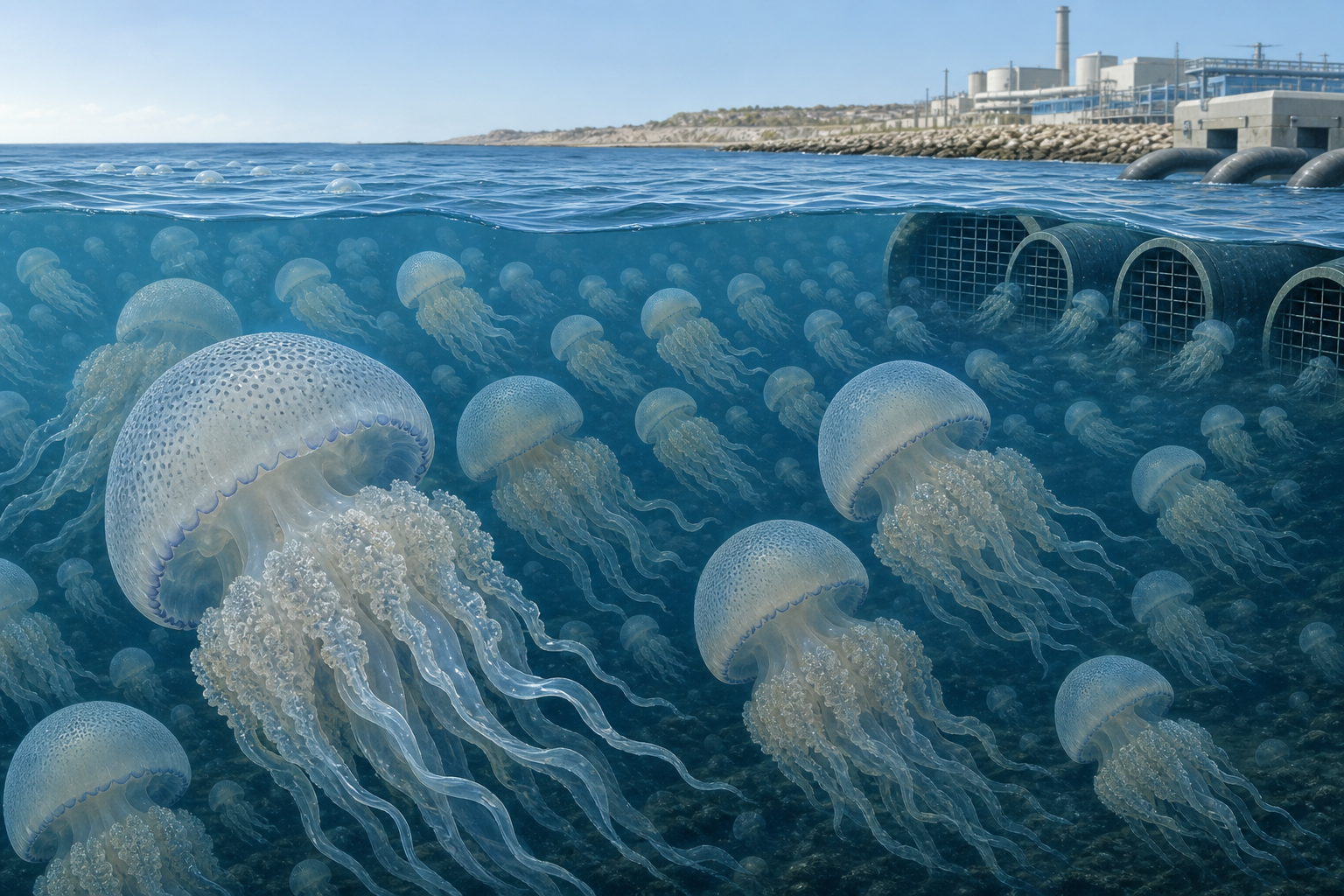
Invasive species on Israel and Levant coasts — summer swarms clog desal intakes.
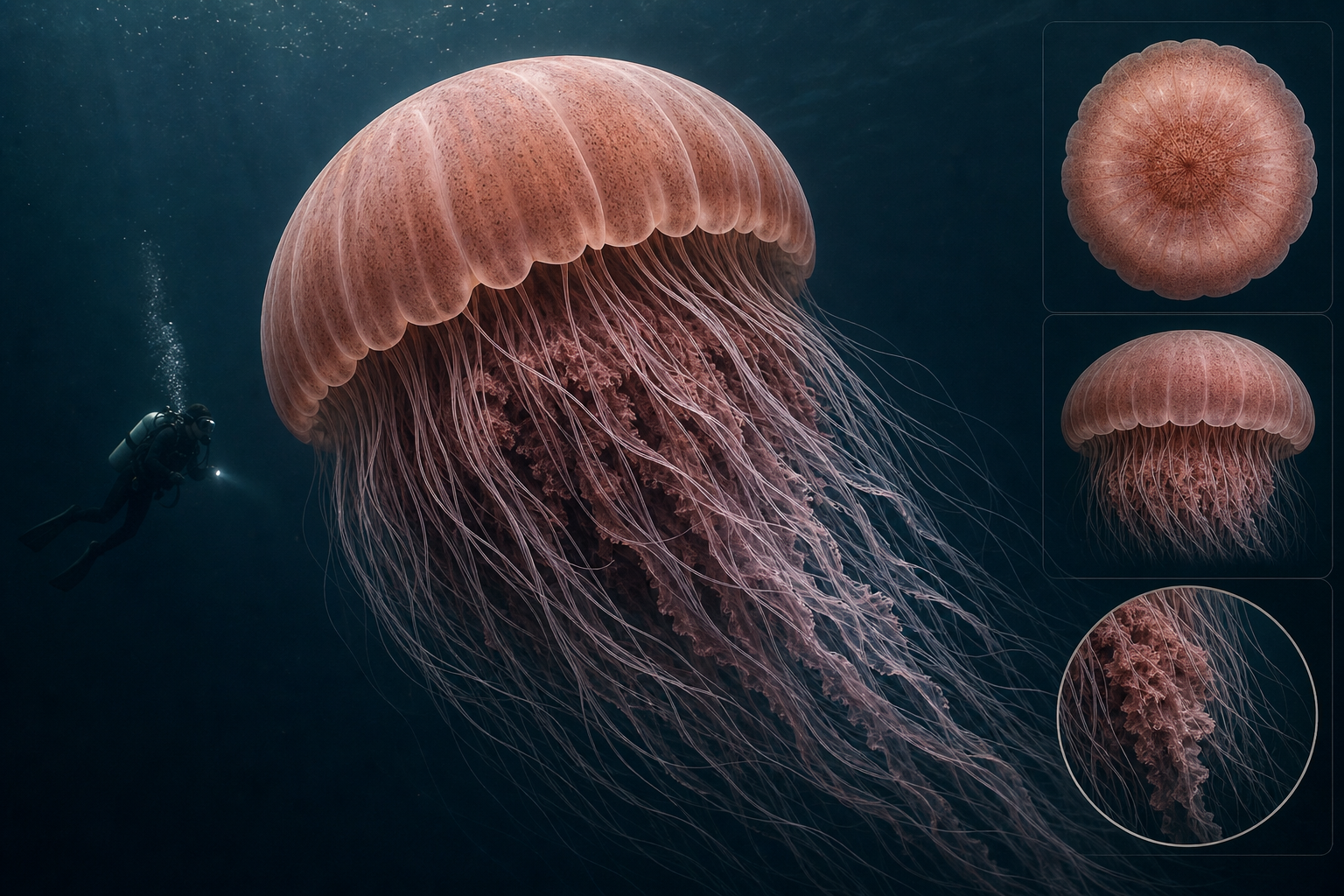
Giant blooms in East Asia — fisheries and water intakes at risk.
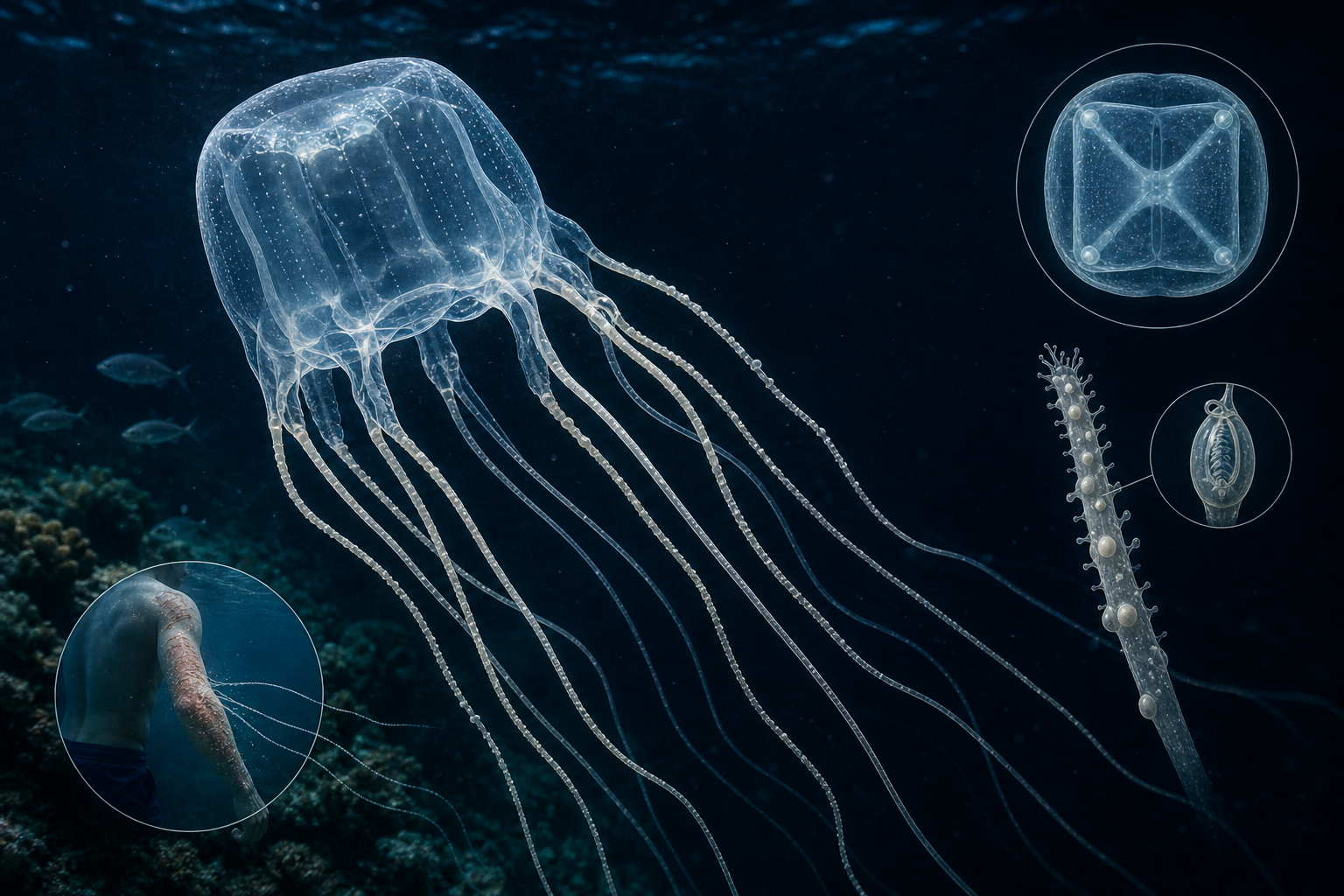
High medical risk — northern Australia, stinger season, yachting safety.
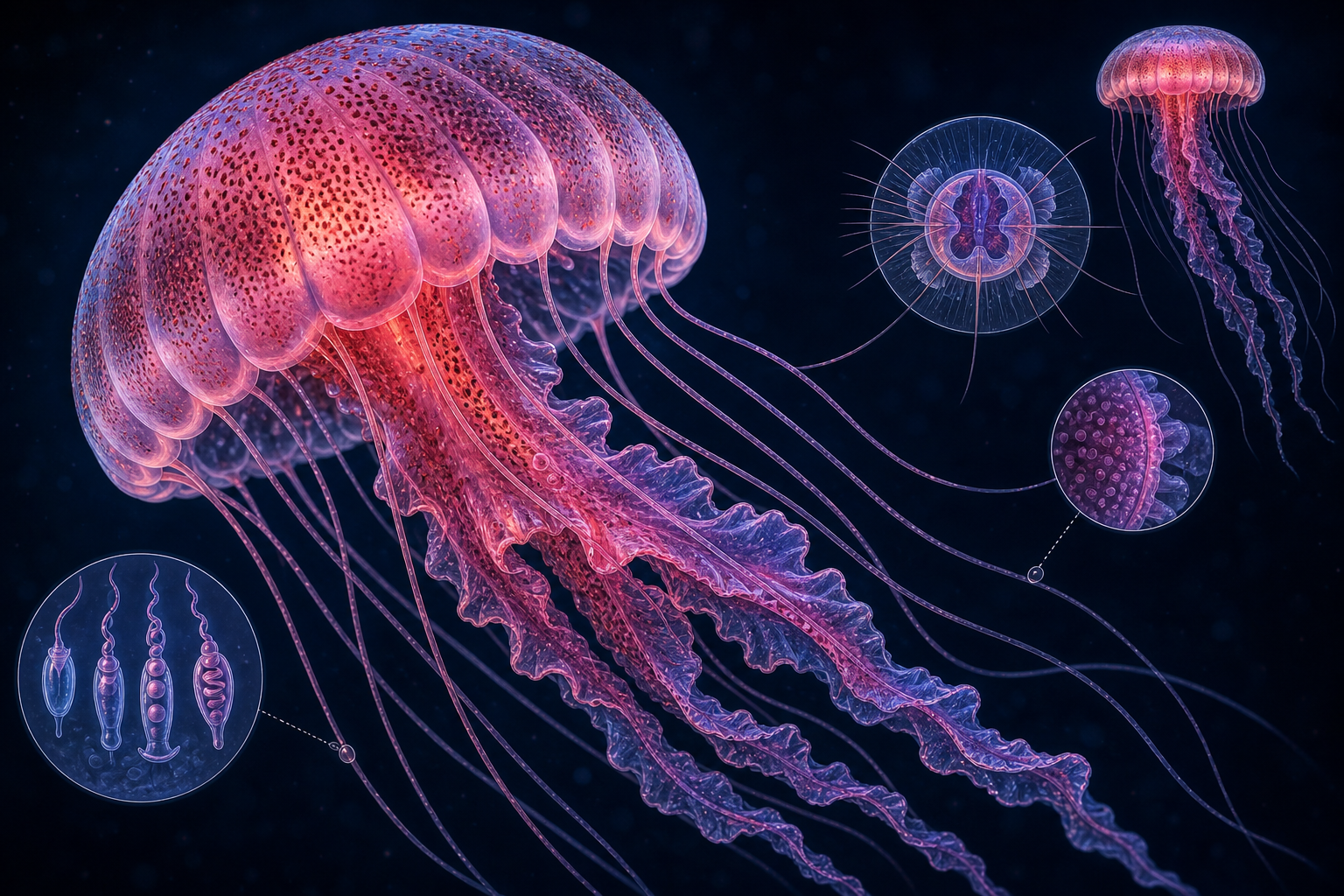
Frequent painful stings in Mediterranean tourist zones.
Sound: what is measured, what is not
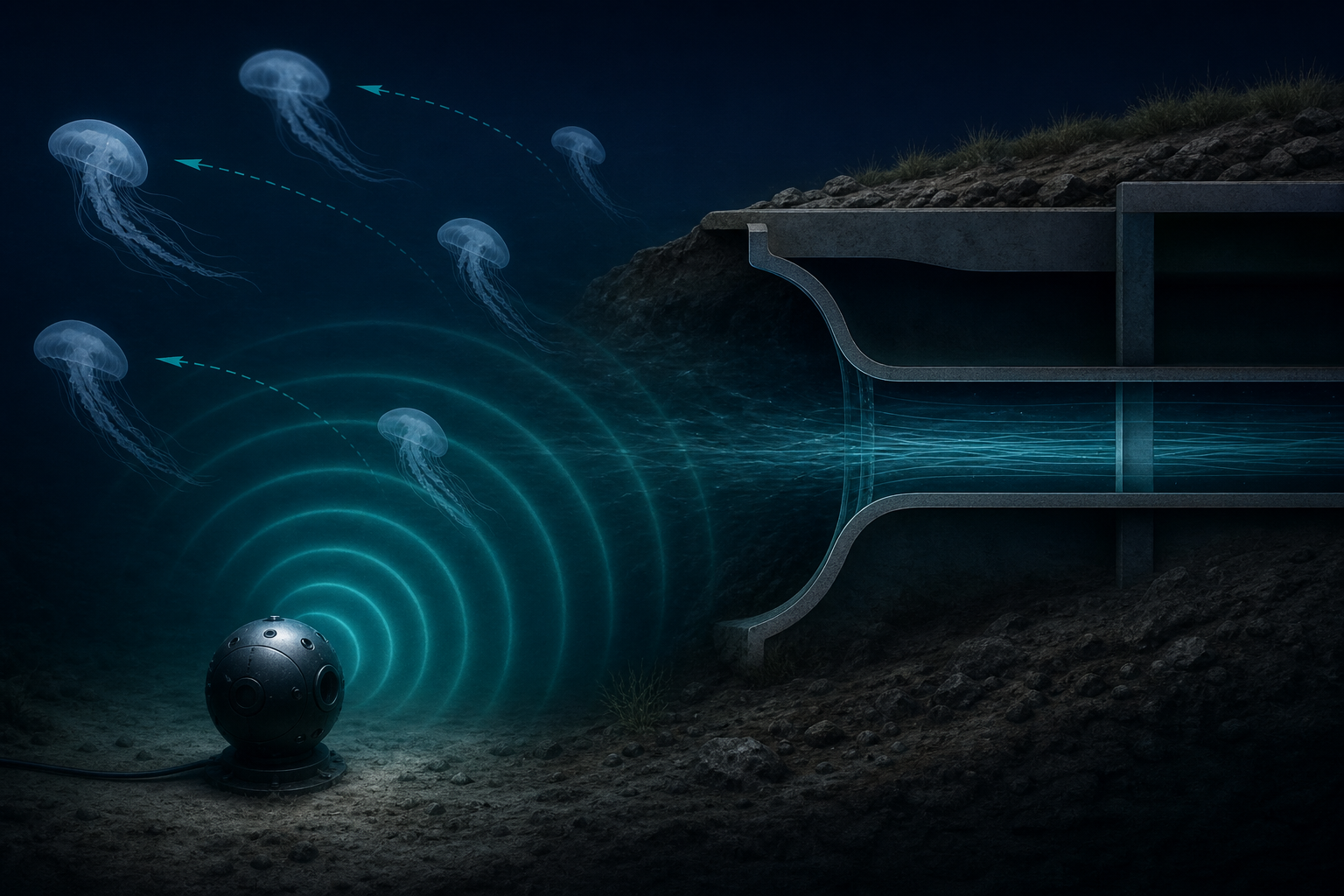
Measured: loud 50–400 Hz sound damages the statocyst (Solé et al., 2016). Not measured: whether a jellyfish moves away from sound at a known dose — no controlled avoidance study exists. The one observation of that kind is qualitative: a hydromedusa turned and swam downward away from a vibrating needle (Horridge, 1966) — a direction of response, but no threshold and no dose. Tuned acoustic deterrents do work for fish at intakes, but their parameters cannot be carried over: a fish has a swim bladder and pressure hearing, a jellyfish has neither.
The open jellyfish question: can you gently steer a swarm aside without damaging balance organs? That is the core testable idea behind HERD.
How people cope today
| Method | Pros | Cons |
|---|---|---|
| Physical nets | Reliable nearshore barrier | Costly and maintenance-heavy |
| Bubble curtains | Useful hydrodynamic exclusion | Energy intensive, site-specific |
| Mechanical removal | Fast short-term reduction | Lethal and ecologically controversial |
| Fish AFD systems | Mature evidence for fish | Not calibrated for jellyfish |
| HERD LF barrier | Potentially humane and scalable | Still in R&D |
HERD network
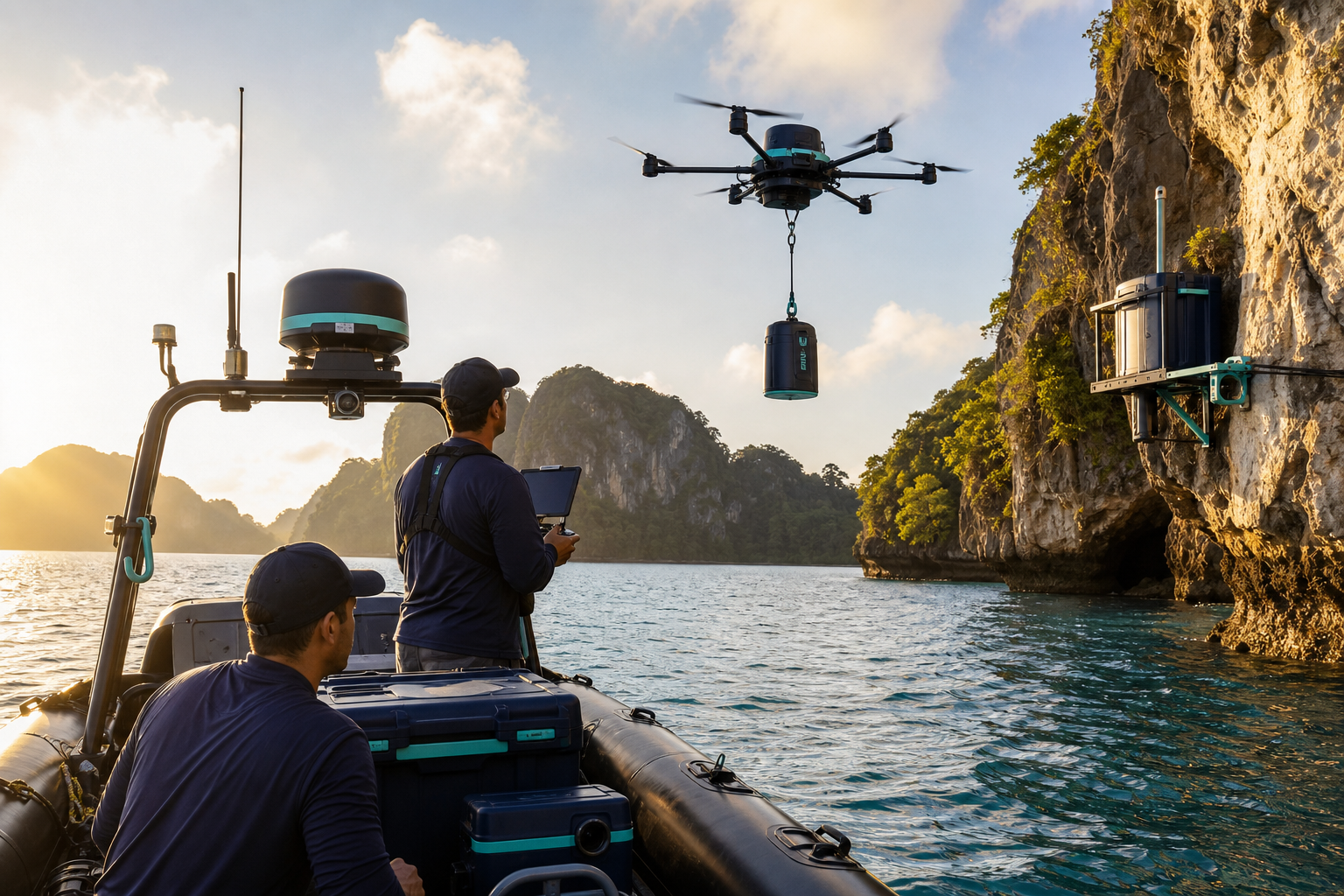
HERD proposes two steps: low-cost coastal sensors catch early signs of swarming, then trials of a gentle sound “corridor” to steer jellyfish away from intakes.
The aim is practical risk management for resorts, ports, and utilities before beaches close or plants trip offline.
241 sources
Each paper gets a short plain-language note. Search by title, author, topic, or tag.
No matches — try another query.
Sources 1-75
- peer-reviewed Sole M. et al. (2016). Evidence of Cnidarians sensitivity to sound after exposure to low frequency noise. Scientific Reports. link
Experimental evidence that cnidarians (jellyfish, corals) detect or respond to low-frequency sound.
- peer-reviewed Wang R. et al. (2021). Jellyfish otolith-inspired MEMS vector hydrophone for low-frequency detection. Microsystems and Nanoengineering. link
Bio-inspired MEMS hydrophone design modeled on jellyfish statocysts for low-frequency underwater sensing.
- review Purcell J.E., Uye S., Lo W.T. (2007). Anthropogenic causes of jellyfish blooms and their direct consequences for humans. Marine Ecology Progress Series. link
Review linking human activities (fishing, eutrophication, climate) to jellyfish blooms and societal impacts.
- peer-reviewed Maes J. et al. (2004). Field evaluation of a sound system to reduce estuarine fish intake rates at a power plant cooling water inlet. Journal of Fish Biology. link
Jellyfish or debris blocking power-plant cooling-water intakes — field tests, incidents, or management guidance.
- peer-reviewed Sonny D. et al. (2006). Reactions of cyprinids to infrasound at a nuclear power plant cooling-water inlet. Journal of Fish Biology. link
Jellyfish or debris blocking power-plant cooling-water intakes — field tests, incidents, or management guidance.
- peer-reviewed Woith H., Petersen G.M., Hainzl S., Dahm T. (2018). Can Animals Predict Earthquakes? Bulletin of the Seismological Society of America. link
Critical review of claims that animals (including marine species) can forecast earthquakes.
- org EPRI (2017). Cooling Water Intake Debris Management: Jellyfish and Jellyfish-Like Organisms. Electric Power Research Institute. link
Jellyfish or debris blocking power-plant cooling-water intakes — field tests, incidents, or management guidance.
- history Spangenberg D.B. (1986). Statocyst structure and function in Cnidaria. Fortschritte der Zoologie.
Balance organ (statocyst) structure and function in gelatinous zooplankton and related invertebrates.
- review Tiemann H. et al. (2009). Gelatinous zooplankton statocyst and sensory biology overview. Marine Ecology.
Balance organ (statocyst) structure and function in gelatinous zooplankton and related invertebrates.
- peer-reviewed Mooney T.A. et al. (2010). Ontogeny of hearing in the squid Loligo pealeii. Biological Bulletin. link
Peer-reviewed research paper on the topic cited above. Focus: «Ontogeny of hearing in the squid Loligo pealeii».
- peer-reviewed Budelmann B.U. (1979). Hair cell responses in the octopus statocyst. Journal of Comparative Physiology.
Balance organ (statocyst) structure and function in gelatinous zooplankton and related invertebrates.
- review Bedard A.J., Georges T.M. (2000). Atmospheric Infrasound. Physics Today. link
Introductory overview of atmospheric infrasound sources, propagation, and monitoring.
- peer-reviewed Elbing B.R., Petrin C.E., Van Den Broeke M.S. (2019). Measurement and characterization of infrasound from a tornado-producing storm. Journal of the Acoustical Society of America. link
Infrasound generated by severe storms, tornadoes, or thunderstorm vortices.
- peer-reviewed Waxler R., Gilbert K.E. (2006). The radiation of atmospheric microbaroms by ocean waves. Journal of the Acoustical Society of America. link
Microbaroms — continuous infrasound from ocean surface waves interacting with the atmosphere.
- peer-reviewed Condon R.H. et al. (2013). Recurrent jellyfish blooms are a consequence of global oscillations. Proceedings of the National Academy of Sciences. link
Large-scale drivers of recurring jellyfish blooms (climate oscillations, fishing, eutrophication).
- review Richardson A.J. et al. (2009). The jellyfish joyride: causes, consequences and management responses to a more gelatinous future. Trends in Ecology and Evolution. link
Policy-oriented review of rising jellyfish dominance in marine ecosystems and management options.
- peer-reviewed Sanz-Martin M. et al. (2018). Claims that anthropogenic stressors facilitate jellyfish blooms have been amplified beyond the available evidence. Frontiers in Marine Science. link
Review linking human activities (fishing, eutrophication, climate) to jellyfish blooms and societal impacts.
- media Gershwin L. (2013). Stung! On Jellyfish Blooms and the Future of the Ocean. University of Chicago Press.
News report or book on jellyfish swarms shutting nuclear plants, desalination, or coastal infrastructure.
- media Sixth Tone (2024). Gridlocked: When Jellyfish Brought a China Power Plant to Its Knees. Sixth Tone. link
News report or book on jellyfish swarms shutting nuclear plants, desalination, or coastal infrastructure.
- review Graham W.M. et al. (2014). Linking human well-being and jellyfish ecosystem services and disservices. Current Opinion in Environmental Sustainability. link
Ecosystem services jellyfish provide (carbon cycling, food web links) alongside their nuisances.
- org European Commission (2011). EcoJel project: jellyfish occurrence and management in the Irish Sea. European Union Regional Policy. link
Jellyfish biology, blooms, impacts, or management in coastal and open-ocean systems.
- review Uye S. (2008). Blooms of the giant jellyfish Nemopilema nomurai in the East Asian marginal seas: review and synthesis. Plankton and Benthos Research. link
Ecology and fisheries impacts of giant Nomura's jellyfish (Nemopilema nomurai) in East Asian seas.
- media NHK News (2011). Jellyfish affected cooling-water intake operation at Shimane nuclear station. NHK archives.
Jellyfish or debris blocking power-plant cooling-water intakes — field tests, incidents, or management guidance.
- peer-reviewed Dong J. et al. (2010). Bloom dynamics of jellyfish in the Yellow Sea and East China Sea. Progress in Natural Science.
Trends, causes, or ecosystem effects of increasing jellyfish populations and blooms worldwide.
- review Boero F. et al. (2016). Jellyfish surge in the Mediterranean Sea: threat or opportunity? Mediterranean Marine Science. link
Operational guidance or monitoring programs for jellyfish in Mediterranean, Black Sea, or NOAA waters.
- media The Times of Israel (2019). Jellyfish clog desalination plant intake systems during summer blooms. The Times of Israel. link
Jellyfish or debris blocking power-plant cooling-water intakes — field tests, incidents, or management guidance.
- peer-reviewed Fenner P.J., Williamson J.A., Burnett J.W. (2010). Irukandji and Chironex box jellyfish envenomation. Wilderness and Environmental Medicine. link
Medical and ecological aspects of dangerous box jellyfish (Chironex, Irukandji) in Australia and tropics.
- peer-reviewed Brodeur R.D. et al. (2002). Rise and fall of jellyfish in the eastern Bering Sea in relation to climate regime shifts. Progress in Oceanography. link
How climate change and ocean warming influence jellyfish bloom formation.
- peer-reviewed Kideys A.E. (2002). Fall and rise of the Black Sea ecosystem and the anchovy fishery: effects of gelatinous zooplankton on marine food webs. Marine Ecology Progress Series. link
How gelatinous zooplankton reshaped Black Sea food webs and collapsed anchovy fisheries.
- review Pitt K.A., Lucas C.H. (2014). Jellyfish Blooms. Springer. link
Trends, causes, or ecosystem effects of increasing jellyfish populations and blooms worldwide.
- peer-reviewed Brotz L. et al. (2012). Increasing jellyfish populations: trends in large marine ecosystems. Hydrobiologia. link
Trends, causes, or ecosystem effects of increasing jellyfish populations and blooms worldwide.
- peer-reviewed Brotz L. et al. (2012). Global analysis of jellyfish fisheries and blooms. Marine Biology. link
Trends, causes, or ecosystem effects of increasing jellyfish populations and blooms worldwide.
- media BBC News (2011). Torness nuclear power station shut after jellyfish swarm. BBC. link
News report or book on jellyfish swarms shutting nuclear plants, desalination, or coastal infrastructure.
- media The Guardian (2013). Swedish reactor at Oskarshamn shut by jellyfish. The Guardian. link
News report or book on jellyfish swarms shutting nuclear plants, desalination, or coastal infrastructure.
- media Energy Voice (2020). Drones and imaging tested for jellyfish early warning at cooling intakes. Energy Voice. link
Jellyfish biology, blooms, impacts, or management in coastal and open-ocean systems.
- peer-reviewed Burnett J.W., Gable W.D. (1989). A fatal jellyfish envenomation by Chironex fleckeri. Toxicon. link
Medical and ecological aspects of dangerous box jellyfish (Chironex, Irukandji) in Australia and tropics.
- review Popper A.N., Hawkins A.D. (2019). An overview of fish bioacoustics and the impacts of anthropogenic sounds. Journal of Fish Biology. link
Overview of fish hearing and impacts of human-made underwater noise on fish.
- org State Intellectual Property Office of China (2017). CN106973350A: Infrasound jellyfish repelling device. CN Patent. link
How fish react to infrasound near industrial intakes; basis for acoustic fish deterrent (AFD) systems.
- review Nestler J.M. et al. (1992). Behavior barriers and fish guidance systems at water intakes. American Fisheries Society Symposium.
Jellyfish or debris blocking power-plant cooling-water intakes — field tests, incidents, or management guidance.
- peer-reviewed Lo W.T. et al. (2008). Population outbreaks of jellyfish and links to environmental change around Taiwan. Fisheries Science.
Trends, causes, or ecosystem effects of increasing jellyfish populations and blooms worldwide.
- peer-reviewed Arai M.N. (2009). The potential importance of podocysts to the formation of scyphozoan blooms: a review. Hydrobiologia. link
Peer-reviewed research paper on the topic cited above. Focus: «The potential importance of podocysts to the formation of scyphozoan blooms: a review».
- review Purcell J.E. (2012). Jellyfish and ctenophore blooms coincide with human proliferations and environmental perturbations. Annual Review of Marine Science. link
Trends, causes, or ecosystem effects of increasing jellyfish populations and blooms worldwide.
- review Lucas C.H., Gelcich S., Uye S., Brotz L. (2014). Gelatinous zooplankton and ecosystem services. Advances in Marine Biology. link
Review article summarizing current knowledge on the cited topic. Focus: «Gelatinous zooplankton and ecosystem services».
- peer-reviewed Canepa A., Fuentes V., Sabates A., Piraino S., Boero F. (2014). Pelagia noctiluca in Mediterranean coastal systems and implications for tourism and fisheries. Marine Biology.
Pelagia noctiluca blooms in the Mediterranean — tourism, fisheries, and ecosystem effects.
- review Hays G.C., Doyle T.K., Houghton J.D.R. (2018). A paradigm shift in jellyfish research priorities. Frontiers in Marine Science. link
Jellyfish biology, blooms, impacts, or management in coastal and open-ocean systems.
- org FAO (2018). Jellyfish fisheries and aquaculture in Asia: status and prospects. Food and Agriculture Organization. link
Interactions between jellyfish and fisheries — predation, bycatch, or economic losses.
- peer-reviewed Kawahara M., Uye S., Ohtsu K., Iizumi H. (2006). Unusual population explosion of the giant jellyfish Nemopilema nomurai in East Asian waters. Plankton and Benthos Research. link
Ecology and fisheries impacts of giant Nomura's jellyfish (Nemopilema nomurai) in East Asian seas.
- peer-reviewed Sand O., Enger P.S., Karlsen H.E. (2000). Detection of infrasound and linear acceleration in fish and behavioral avoidance responses. Journal of Experimental Biology. link
How fish react to infrasound near industrial intakes; basis for acoustic fish deterrent (AFD) systems.
- org GFCM and FAO (2013). Review of jellyfish blooms in the Mediterranean and Black Sea. GFCM Studies and Reviews. link
How gelatinous zooplankton reshaped Black Sea food webs and collapsed anchovy fisheries.
- review Graham W.M., Martin D.L., Felder D.L., Asper V.L., Perry H.M. (2003). Ecological and economic implications of gelatinous zooplankton blooms. Marine Ecology Progress Series. link
Review article summarizing current knowledge on the cited topic. Focus: «Ecological and economic implications of gelatinous zooplankton blooms».
- peer-reviewed Bedard A.J. (2005). Low-frequency atmospheric acoustic energy associated with vortices produced by thunderstorms. Monthly Weather Review. link
Infrasound generated by severe storms, tornadoes, or thunderstorm vortices.
- peer-reviewed Marchetti E., Ripepe M., Ulivieri G., Kogelnig A. (2015). Infrasound array criteria for automatic detection and front velocity estimation of snow avalanches. Natural Hazards and Earth System Sciences. link
Infrasound arrays for automatic avalanche detection and front-velocity estimation in mountains.
- peer-reviewed Mayer S., van Herwijnen A., Ulivieri G., Schweizer J. (2020). Evaluating the performance of an operational infrasound avalanche detection system. Cold Regions Science and Technology. link
Infrasound arrays for automatic avalanche detection and front-velocity estimation in mountains.
- org Wyssen Avalanche Control AG (2024). IDA Infrasound Detection System for avalanches. Wyssen technical documentation. link
Infrasound arrays for automatic avalanche detection and front-velocity estimation in mountains.
- review van Kamp I., van den Berg F. (2018). Health effects related to wind turbine sound, including low-frequency sound and infrasound. Acoustics Australia. link
Scientific review of health complaints vs. wind-turbine low-frequency sound and infrasound exposure.
- review McCunney R.J., Mundt K.A., Colby W.D., Dobie R., Kaliski K., Blais M. (2014). Wind turbines and health: a critical review of the scientific literature. Journal of Occupational and Environmental Medicine. link
Scientific review of health complaints vs. wind-turbine low-frequency sound and infrasound exposure.
- org JASON Advisory Group (2018). An analysis of hypotheses related to embassy health incidents. U.S. Department of State report. link
Investigation of reported sonic/infrasonic embassy incidents (Havana syndrome) and alternative explanations.
- peer-reviewed Stubbs A.L., Montealegre-Z F. (2019). Recording of sonic attacks on U.S. diplomats in Cuba spectrally matches the calling song of a Caribbean cricket. bioRxiv. link
Investigation of reported sonic/infrasonic embassy incidents (Havana syndrome) and alternative explanations.
- org Raspberry Shake S.A. (2026). Raspberry Shake and Boom citizen seismo-acoustic network. Raspberry Shake. link
Citizen seismo-acoustic network hardware (Raspberry Shake/Boom) for low-cost ground and air monitoring.
- org Bosch Sensortec (2026). BMP388 high-accuracy barometric pressure sensor. Product documentation. link
High-accuracy barometric MEMS sensor (BMP388 class) usable for infrasound and microbarom studies.
- org ARISE Consortium (2026). Atmospheric dynamics Research InfraStructure in Europe. ARISE project. link
ARISE European research infrastructure integrating infrasound, lidar, and radar for atmospheric dynamics.
- review Fee D., Matoza R.S. (2013). An overview of volcano infrasound: from Hawaiian to Plinian, local to global. Journal of Volcanology and Geothermal Research. link
Using infrasound to detect, locate, and warn of volcanic eruptions from local to global scale.
- review Watson L.M., Matoza R.S., Fee D., et al. (2022). Volcano infrasound: progress and future directions. Bulletin of Volcanology. link
Using infrasound to detect, locate, and warn of volcanic eruptions from local to global scale.
- peer-reviewed Moller H., Pedersen C.S. (2004). Hearing at low and infrasonic frequencies. Noise and Health. link
Peer-reviewed research paper on the topic cited above. Focus: «Hearing at low and infrasonic frequencies».
- peer-reviewed Ardhuin F., Stutzmann E., Schimmel M., Mangeney A. (2011). Ocean wave sources of seismic noise. Journal of Geophysical Research: Oceans. link
Peer-reviewed research paper on the topic cited above. Focus: «Ocean wave sources of seismic noise».
- peer-reviewed Langbauer W.R., Payne K.B., Charif R.A., Rapaport L., Osborn F. (1991). African elephants respond to distant playbacks of low-frequency conspecific calls. Journal of Experimental Biology. link
How elephants use low-frequency calls and ground-borne vibrations for communication and navigation.
- peer-reviewed Garstang M. et al. (2005). The daily cycle of low-frequency elephant calls and near-surface atmospheric conditions. Earth Interactions. link
Peer-reviewed research paper on the topic cited above. Focus: «The daily cycle of low-frequency elephant calls and near-surface atmospheric conditions».
- peer-reviewed Edwards W.N., Brown P.G., ReVelle D.O. (2006). Estimates of meteoroid kinetic energies from observations of infrasonic airwaves. Journal of Atmospheric and Solar-Terrestrial Physics. link
Estimating meteoroid energy and trajectory from infrasonic airwaves of bolides and fireballs.
- peer-reviewed McDonald M.A., Hildebrand J.A., Mesnick S. (2009). Worldwide decline in tonal frequencies of blue whale songs. Endangered Species Research. link
Blue/fin whale vocalizations, source levels, propagation, or long-term song frequency trends.
- peer-reviewed Hedlin M.A.H., Alcoverro B., D'Spain G. (2003). Evaluation of rosette infrasonic noise-reducing spatial filters. Journal of the Acoustical Society of America. link
Spatial filter designs (rosette arrays) to reduce wind noise in infrasound measurements.
- peer-reviewed Assink J.D., Averbuch G., Shani-Kadmiel S., Smets P., Evers L. (2018). A seismo-acoustic analysis of the 2017 North Korean nuclear test. Seismological Research Letters. link
Joint seismic and infrasound analysis locating and characterizing underground nuclear explosions.
- peer-reviewed Anderson J.F., Johnson J.B., Bowman D.C., Ronan T.J. (2018). The Gem infrasound logger and custom-built instrumentation. Seismological Research Letters. link
Low-cost infrasound logger hardware (Gem and similar) for field and educational monitoring.
- peer-reviewed Marcillo O., Johnson J.B., Hart D. (2012). An inexpensive low-power low-noise infrasound sensor for local and regional monitoring. Journal of Atmospheric and Oceanic Technology. link
Design of affordable, low-power infrasound sensors for dense local and regional networks.
- peer-reviewed Clive M.A. et al. (2024). Crowdsourcing human observations expands and enhances volcano monitoring records. Communications Earth and Environment. link
Combining citizen observations with instrument data to improve volcano monitoring records.
- peer-reviewed Cansi Y. (1995). An automatic seismic event processing for detection and location: the PMCC method. Geophysical Research Letters. link
PMCC algorithm — standard method for detecting and locating infrasonic phases on array data.
Sources 76-150
- peer-reviewed Vergoz J. et al. (2022). International Monitoring System infrasound data products for atmospheric studies and civilian applications. Earth System Science Data. link
CTBTO International Monitoring System infrasound stations and open data for science and civil use.
- peer-reviewed Kubota T., Saito T., Nishida K. (2022). Global fast-traveling tsunamis driven by atmospheric Lamb waves on the 2022 Tonga eruption. Science. link
Global seismo-acoustic signals from the 2022 Hunga Tonga eruption — Lamb waves and tsunamis.
- peer-reviewed Streby H.M. et al. (2015). Tornadic storm avoidance behavior in breeding songbirds. Current Biology. link
Birds detecting distant severe weather via infrasound and evacuating breeding sites before tornadoes.
- peer-reviewed Bishop J.W. et al. (2022). Deep learning categorization of infrasound array data. Journal of the Acoustical Society of America. link
Machine-learning classification of infrasound array recordings for automated event detection.
- peer-reviewed Jesus M.C. et al. (2024). Low-cost small-aperture arrays improve infrasound monitoring in the Azores. Pure and Applied Geophysics. link
Affordable infrasound arrays or mobile platforms (INFRA-EAR, small-aperture) for regional monitoring.
- peer-reviewed Den Ouden O.F.C., Assink J.D., Oudshoorn C.D., Filippi D., Evers L.G. (2021). The INFRA-EAR low-cost mobile infrasound platform. Atmospheric Measurement Techniques. link
Affordable infrasound arrays or mobile platforms (INFRA-EAR, small-aperture) for regional monitoring.
- peer-reviewed Lamb O.D. et al. (2021). Assessing Raspberry Shake and Boom sensors for recording African elephant vocalizations. Frontiers in Conservation Science. link
Citizen seismo-acoustic network hardware (Raspberry Shake/Boom) for low-cost ground and air monitoring.
- peer-reviewed Brissaud Q. et al. (2021). First detection of an earthquake from a balloon using its acoustic signature. Geophysical Research Letters. link
Detecting earthquakes from high-altitude balloon recordings of acoustic signatures.
- peer-reviewed Ravanelli M. et al. (2023). Tsunami and Lamb-wave ionospheric signatures from the 2022 Tonga eruption. Pure and Applied Geophysics. link
Global seismo-acoustic signals from the 2022 Hunga Tonga eruption — Lamb waves and tsunamis.
- review Duarte C.M. et al. (2021). The soundscape of the Anthropocene ocean. Science. link
Review of human-made and natural ocean soundscapes in the Anthropocene era.
- review Woith H., Petersen G.M., Hainzl S., Dahm T. (2018). Earthquake prediction by animals revisited: evidence standards and limitations. Bulletin of the Seismological Society of America. link
Review article summarizing current knowledge on the cited topic. Focus: «Earthquake prediction by animals revisited: evidence standards and limitations».
- peer-reviewed Allen R.M. et al. (2025). Global earthquake detection and warning using Android phones. Science. link
Using smartphone accelerometers globally for earthquake detection and early warning.
- peer-reviewed Johnson J.B. et al. (2023). Infrasound detection of approaching lahars. Scientific Reports. link
Infrasound signatures of approaching lahars (volcanic mudflows) for early warning.
- peer-reviewed Marchetti E. et al. (2019). Infrasound array analysis of debris-flow activity and implications for early warning. Journal of Geophysical Research: Earth Surface. link
Infrasound monitoring of debris flows for hazard early warning in mountains.
- peer-reviewed Crichton F., Dodd G., Schmid G., Gamble G., Petrie K.J. (2014). The link between health complaints and wind turbines: support for the nocebo expectations hypothesis. Frontiers in Public Health. link
Scientific review of health complaints vs. wind-turbine low-frequency sound and infrasound exposure.
- history Tandy V., Lawrence T.R. (1998). The ghost in the machine. Journal of the Society for Psychical Research. link
Classic note linking infrasound from fans to haunted-building sensations (19 Hz resonance).
- peer-reviewed von Muggenthaler E. (2000). Infrasonic and low-frequency vocalizations from Siberian and Bengal tigers. Journal of the Acoustical Society of America. link
Infrasonic and low-frequency vocalizations in big cats (tigers) for long-range communication.
- peer-reviewed Watkins W.A. et al. (2004). Twelve years of tracking 52-Hz whale calls from a unique source in the North Pacific. Deep-Sea Research Part I. link
Blue/fin whale vocalizations, source levels, propagation, or long-term song frequency trends.
- peer-reviewed Ripepe M. et al. (2018). Infrasonic early warning system for explosive eruptions. Journal of Geophysical Research: Solid Earth. link
Peer-reviewed research paper on the topic cited above. Focus: «Infrasonic early warning system for explosive eruptions».
- peer-reviewed Ripepe M. et al. (2021). Dense seismo-acoustic network warning of the 2019 paroxysmal Stromboli eruptions. Scientific Reports. link
Peer-reviewed research paper on the topic cited above. Focus: «Dense seismo-acoustic network warning of the 2019 paroxysmal Stromboli eruptions».
- org NOAA PMEL (2026). The Bloop and cryogenic icequake source identification. NOAA PMEL Acoustics Program. link
NOAA identification of the famous «Bloop» sound as ice-related, not biological.
- peer-reviewed Mack A.L., Jones J. (2003). Low-frequency vocalizations by cassowaries Casuarius spp. The Auk. link
Peer-reviewed research paper on the topic cited above. Focus: «Low-frequency vocalizations by cassowaries Casuarius spp».
- peer-reviewed Hetzer C.H., Gilbert K.E., Waxler R., Talmadge C.L. (2008). Infrasound from hurricanes and dependence on ocean surface-wave fields. Geophysical Research Letters. link
Infrasound radiated by hurricanes and its dependence on ocean surface waves.
- peer-reviewed De Carlo M., Ardhuin F., Le Pichon A. (2020). Atmospheric infrasound generation by ocean waves in finite depth. Geophysical Journal International. link
Research on atmospheric or ocean-coupled infrasound sources, propagation, or monitoring.
- peer-reviewed Reber S.A. et al. (2017). Formants provide honest acoustic cues to body size in American alligators. Scientific Reports. link
Alligator bellows use infrasonic formants as honest cues to body size in mating.
- peer-reviewed Freeman A.R., Hare J.F. (2015). Infrasound in mating displays: a peacock's tale. Animal Behaviour. link
Peacock mating displays include infrasonic components detectable by females.
- peer-reviewed Barklow W.E. (2004). Low-frequency sounds and amphibious communication in Hippopotamus amphibius. Journal of the Acoustical Society of America. link
Low-frequency underwater and amphibious communication in hippopotamuses.
- peer-reviewed Wilson C.R., Olson J.V. (2005). High trace-velocity infrasound from pulsating auroras at Fairbanks, Alaska. Geophysical Research Letters. link
Infrasound coupled to pulsating aurora and upper-atmosphere energy deposition.
- peer-reviewed Longuet-Higgins M.S. (1950). A theory of the origin of microseisms. Philosophical Transactions of the Royal Society A. link
Theory and observations of microseisms — seismic noise driven by ocean waves.
- peer-reviewed Campus P., Christie D.R. (2010). Worldwide observations of infrasonic waves. Infrasound Monitoring for Atmospheric Studies. link
Research on atmospheric or ocean-coupled infrasound sources, propagation, or monitoring.
- peer-reviewed Le Pichon A., Blanc E., Hauchecorne A. (2010). Infrasound Monitoring for Atmospheric Studies. Springer. link
Research on atmospheric or ocean-coupled infrasound sources, propagation, or monitoring.
- peer-reviewed Matoza R.S. et al. (2022). Atmospheric waves and global seismoacoustic observations of the January 2022 Hunga eruption. Science. link
Peer-reviewed research paper on the topic cited above. Focus: «Atmospheric waves and global seismoacoustic observations of the January 2022 Hunga eruption».
- peer-reviewed Le Pichon A. et al. (2013). The 2013 Russian fireball largest ever detected by CTBTO infrasound sensors. Geophysical Research Letters. link
Estimating meteoroid energy and trajectory from infrasonic airwaves of bolides and fireballs.
- peer-reviewed Le Pichon A. et al. (2005). Infrasound associated with 2004-2005 large Sumatra earthquakes and tsunami. Geophysical Research Letters. link
Infrasound and seismo-acoustic observations of the 2004 Sumatra earthquake and tsunami.
- review Garces M. et al. (2005). Infrasound associated with the 2004 Sumatra megathrust earthquake and tsunami. Acoustical Society of America lay language paper. link
Infrasound and seismo-acoustic observations of the 2004 Sumatra earthquake and tsunami.
- peer-reviewed Bittner M., Hoppner K., Pilger C., Schmidt C. (2010). Mesopause temperature perturbations caused by infrasonic waves as a potential indicator for detection of tsunamis. Natural Hazards and Earth System Sciences. link
Peer-reviewed research paper on the topic cited above. Focus: «Mesopause temperature perturbations caused by infrasonic waves as a potential indicator for detection of tsunamis».
- history Symons G.J. (1888). The Eruption of Krakatoa and Subsequent Phenomena. Royal Society. link
Historic Krakatoa 1883 eruption — among the loudest infrasonic events recorded globally.
- review Gabrielson T.B. (2004). Krakatoa and the Royal Society: the Krakatoa explosion of 1883. Acoustics Today. link
Historic Krakatoa 1883 eruption — among the loudest infrasonic events recorded globally.
- media Cox A. (2014). The sound so loud that it circled the Earth four times. Nautilus. link
News article or popular book reporting jellyfish/infrasound events or trends. Focus: «The sound so loud that it circled the Earth four times».
- peer-reviewed Payne K.B., Langbauer W.R., Thomas E.M. (1986). Infrasonic calls of the Asian elephant Elephas maximus. Behavioral Ecology and Sociobiology. link
How elephants use low-frequency calls and ground-borne vibrations for communication and navigation.
- peer-reviewed O'Connell-Rodwell C.E. (2007). Keeping an ear to the ground: seismic communication in elephants. Physiology. link
How elephants use low-frequency calls and ground-borne vibrations for communication and navigation.
- peer-reviewed Mortimer B., Rees W.L., Koelemeijer P., Nissen-Meyer T. (2018). Classifying elephant behaviour through seismic vibrations. Current Biology. link
How elephants use low-frequency calls and ground-borne vibrations for communication and navigation.
- org Elephant Listening Project (2026). Forest elephant acoustic monitoring methods and data. Cornell University. link
Report, patent, or technical documentation from an organization or industry body. Focus: «Forest elephant acoustic monitoring methods and data».
- org NOAA Ocean Explorer (2026). The SOFAR channel and long-range underwater sound propagation. NOAA. link
Report, patent, or technical documentation from an organization or industry body. Focus: «The SOFAR channel and long-range underwater sound propagation».
- peer-reviewed Cummings W.C., Thompson P.O. (1971). Underwater sounds from the blue whale Balaenoptera musculus. Journal of the Acoustical Society of America. link
Blue/fin whale vocalizations, source levels, propagation, or long-term song frequency trends.
- peer-reviewed Sirovic A., Hildebrand J.A., Wiggins S.M. (2007). Blue and fin whale call source levels and propagation range in the Southern Ocean. Journal of the Acoustical Society of America. link
Blue/fin whale vocalizations, source levels, propagation, or long-term song frequency trends.
- peer-reviewed Hagstrum J.T. (2013). Atmospheric propagation modeling indicates homing pigeons use loft-specific infrasound for navigation. Journal of Experimental Biology. link
Hypothesis and evidence that homing pigeons navigate using loft-specific infrasonic maps.
- peer-reviewed Mills C.E. (2001). Jellyfish blooms: are populations increasing globally in response to changing ocean conditions? Hydrobiologia. link
Large-scale drivers of recurring jellyfish blooms (climate oscillations, fishing, eutrophication).
- review Purcell J.E. (2005). Climate effects on formation of jellyfish and ctenophore blooms: a review. Journal of the Marine Biological Association of the United Kingdom. link
Trends, causes, or ecosystem effects of increasing jellyfish populations and blooms worldwide.
- review Pitt K.A., Welsh D.T., Condon R.H. (2011). Influence of jellyfish blooms on carbon, nutrient and oxygen dynamics and pelagic-benthic coupling. Marine Ecology Progress Series. link
Trends, causes, or ecosystem effects of increasing jellyfish populations and blooms worldwide.
- peer-reviewed Lynam C.P., Gibbons M.J., Axelsen B.E., Sparks C.A.J., Coetzee J., Heywood B.G., Brierley A.S. (2006). Jellyfish overtake fish in a heavily fished ecosystem. Current Biology. link
Jellyfish biology, blooms, impacts, or management in coastal and open-ocean systems.
- peer-reviewed Licandro P., Conway D.V.P., Daly Yahia M.N., Fernandez de Puelles M.L., Gasparini S., Hecq J.H., Tranter P., Kirby R.R. (2010). A blooming jellyfish in the Northeast Atlantic and Mediterranean. Biology Letters. link
Trends, causes, or ecosystem effects of increasing jellyfish populations and blooms worldwide.
- peer-reviewed Doyle T.K., Hays G.C., Harrod C., Houghton J.D.R. (2014). Ecological and societal benefits of jellyfish. In Jellyfish Blooms. Springer. link
Trends, causes, or ecosystem effects of increasing jellyfish populations and blooms worldwide.
- peer-reviewed Mianzan H.W., Mari N., Prenski B., Sanchez F. (2001). Fish predation on Neritic medusae from the Argentine coast. Fisheries Research. link
Peer-reviewed research paper on the topic cited above. Focus: «Fish predation on Neritic medusae from the Argentine coast».
- peer-reviewed Schnedler-Meyer N.A., Mariani P., Kiørboe T. (2018). The global susceptibility of coastal plankton communities to jellyfish predation under climate change. Scientific Reports. link
Interactions between jellyfish and fisheries — predation, bycatch, or economic losses.
- peer-reviewed Kawahara M., Uye S. (2012). Seasonal cycles and fisheries impacts of Nemopilema nomurai in the Japan Sea. Fisheries Oceanography.
Ecology and fisheries impacts of giant Nomura's jellyfish (Nemopilema nomurai) in East Asian seas.
- peer-reviewed Purcell J.E., Malej A., Benovic A. (1999). Potential links of jellyfish to eutrophication and fisheries in the Adriatic Sea. Scientia Marina.
Interactions between jellyfish and fisheries — predation, bycatch, or economic losses.
- peer-reviewed Brotz L., Cheung W.W.L., Kleisner K., Pakhomov E., Pauly D. (2012). Increasing jellyfish populations in developing marine ecosystems and fisheries implications. Marine Biology. link
Trends, causes, or ecosystem effects of increasing jellyfish populations and blooms worldwide.
- media Reuters (2011). Jellyfish force shutdown at Torness nuclear power station in Scotland. Reuters. link
News report or book on jellyfish swarms shutting nuclear plants, desalination, or coastal infrastructure.
- media Japan Times (2009). Giant Nomura jellyfish plague fisheries and coasts in western Japan. Japan Times. link
Interactions between jellyfish and fisheries — predation, bycatch, or economic losses.
- media ABC News Australia (2023). Box jellyfish and Irukandji season affects tourism and beach safety in northern Australia. ABC. link
Medical and ecological aspects of dangerous box jellyfish (Chironex, Irukandji) in Australia and tropics.
- media Bangkok Post (2024). Jellyfish blooms and beach-warning campaigns on Thailand coasts. Bangkok Post. link
Trends, causes, or ecosystem effects of increasing jellyfish populations and blooms worldwide.
- org NOAA Fisheries (2026). Understanding and responding to harmful jellyfish blooms in U.S. waters. NOAA. link
Trends, causes, or ecosystem effects of increasing jellyfish populations and blooms worldwide.
- org FAO (2021). The State of World Fisheries and Aquaculture 2021: aquatic food systems and climate resilience. Food and Agriculture Organization. link
Report, patent, or technical documentation from an organization or industry body. Focus: «The State of World Fisheries and Aquaculture 2021: aquatic food systems and climate resilience».
- org GFCM (2024). Jellyfish Monitoring in the Mediterranean and Black Sea: operational guidance update. General Fisheries Commission for the Mediterranean. link
How gelatinous zooplankton reshaped Black Sea food webs and collapsed anchovy fisheries.
- peer-reviewed Southall B.L. et al. (2007). Marine mammal noise exposure criteria: initial scientific recommendations. Aquatic Mammals. link
Scientific criteria for safe noise exposure levels for marine mammals (shipping, sonar).
- peer-reviewed Southall B.L. et al. (2019). Marine mammal noise exposure criteria: updated scientific recommendations for residual hearing effects. Aquatic Mammals. link
Scientific criteria for safe noise exposure levels for marine mammals (shipping, sonar).
- review Hildebrand J.A. (2009). Anthropogenic and natural sources of ambient noise in the ocean. Marine Ecology Progress Series. link
Natural vs. human-made ambient noise in the ocean and impacts on marine life.
- review Erbe C., Marley S.A., Schoeman R.P., Smith J.N., Trigg L.E., Embling C.B. (2019). The effects of ship noise on marine mammals: a review. Frontiers in Marine Science. link
Scientific criteria for safe noise exposure levels for marine mammals (shipping, sonar).
- history Urick R.J. (1983). Principles of Underwater Sound. McGraw-Hill.
Foundational textbook on underwater acoustics propagation, sonar, and ocean sound channels.
- review Au W.W.L., Hastings M.C. (2008). Principles of Marine Bioacoustics. Springer. link
Principles of marine bioacoustics — how marine animals produce and perceive sound.
- org Google Patents (2018). CN108230302A: Method for detecting and disposing marine organisms invading nuclear-power-plant cold-source intake sea areas. Chinese patent publication. link
Jellyfish or debris blocking power-plant cooling-water intakes — field tests, incidents, or management guidance.
- org Google Patents (2025). US20250351805A1: Sensor-controlled bubble emission system for aquaculture (jellyfish/sea-lice deflection). US patent application. link
Patent or engineering concept for acoustic, bubble, or mechanical jellyfish deterrence at seawater intakes.
- org Google Patents (2019). CN107524123B: Movable marine floating-object interception and dredging net for jellyfish at industrial seawater intakes. Chinese patent publication. link
Patent or engineering concept for acoustic, bubble, or mechanical jellyfish deterrence at seawater intakes.
- org CTBTO Preparatory Commission (2026). Infrasound stations in the International Monitoring System. CTBTO. link
CTBTO International Monitoring System infrasound stations and open data for science and civil use.
Sources 151-196
- peer-reviewed Nakanishi N., Hartenstein V., Jacobs D.K. (2009). Development of the rhopalial nervous system in Aurelia sp.1 (Cnidaria, Scyphozoa). Development Genes and Evolution 219(6), 301-317. link
Confocal study showing gravity-sensing lithocyst and touch plate differentiate first in rhopalium development — core anatomy for how jellyfish statocysts wire into swimming control.
- peer-reviewed Becker A. et al. (2005). Calcium sulfate hemihydrate is the inorganic mineral in statoliths of Scyphozoan medusae (Cnidaria). Dalton Transactions 8, 1545-1550. link
Identifies bassanite (CaSO4·0.5H2O) as the gravity-sensing crystal in scyphozoan statoliths across five species — foundational mineralogy for statocyst function.
- peer-reviewed Horridge G.A. (1969). Statocysts of medusae and evolution of stereocilia. Tissue and Cell 1(2), 341-353. link
Classic hypothesis that jellyfish statocysts evolved from vibration receptors — kinocilium as transducer; directly relevant to vibration/hearing ancestry debate.
- peer-reviewed Singla C.L. (1975). Statocysts of hydromedusae. Cell and Tissue Research 158(3), 391-407. link
Ultrastructure of hydromedusan statocysts with kinocilia and stereocilia — comparative cnidarian balance organ reference beyond scyphozoans.
- peer-reviewed Baranyk J. et al. (2025). Structural, molecular and developmental evidence for cell-type diversity in cnidarian mechanosensory neurons. Nature Communications 16, 56115. link
Shows two mechanosensory hair-cell types in Nematostella with distinct polycystin-1/TRP roles for gentle vs harsh touch — molecular framework likely transferable to jellyfish statocyst hair cells.
- peer-reviewed Hündgen M., Biela C. (1982). Fine structure of touch-plates in the scyphomedusan Aurelia aurita. Journal of Ultrastructure Research 80(2), 178-184. link
EM of Aurelia rhopalium touch-plate hair cells — the mechanoreceptor partner to the lithocyst in gravity and likely vibration sensing.
- peer-reviewed Sötje I. et al. (2011). Comparison of the statolith structures of Chironex fleckeri (Cubozoa) and Periphylla periphylla (Scyphozoa): a phylogenetic approach. Marine Biology 158(5), 1149-1161. link
Comparative statolith morphology across cubozoan and scyphozoan rhopalia — phylogenetic context for gravity-sensor evolution in box vs moon jellyfish.
- peer-reviewed Holst S., Sötje I. (2011). Assessment of investigation techniques for scyphozoan statoliths, with focus on early development of the jellyfish Sanderia malayensis. Marine Ecology Progress Series 433, 241-254. link
Methods paper confirming bassanite statolith composition and growth rings — enables age/development tracking tied to statocyst gravity function.
- peer-reviewed Tiemann H. et al. (2006). Calcium sulfate hemihydrate (bassanite) statoliths in the cubozoan Carybdea sp.. Zoologischer Anzeiger 245(1), 13-17. link
Confirms bassanite statoliths in box jellyfish Carybdea — extends gravity-sensor mineralogy to cubozoan statocysts relevant to dangerous coastal species.
- peer-reviewed Albert D.J. (2007). Adaptive behaviours of the jellyfish Aurelia labiata in Roscoe Bay on the west coast of Canada. Journal of Sea Research 59(3), 198-201. link
Field observations that Aurelia dive below turbulent ebb streams — key behavioral evidence that water motion/vibration cues drive statocyst-mediated depth control.
- peer-reviewed Albert D.J. (2006). Aurelia labiata medusae (Scyphozoa) in Roscoe Bay avoid tidal dispersion by vertical migration. Journal of Sea Research 57(4), 281-287. link
Documents vertical migration behavior modulated by water-column depth and currents — links statocyst-guided swimming to population retention under hydrodynamic forcing.
- review Solé M. et al. (2023). Marine invertebrates and noise. Frontiers in Marine Science 10:1129057. link
Comprehensive André-lab review of invertebrate sound detection and anthropogenic noise impacts including cnidarian statocysts — frames regulatory and R&D context beyond Solé 2016.
- peer-reviewed Edwards C.B. et al. (2024). Marine and Freshwater Sounds Impact Invertebrate Behavior and Physiology: A Meta-Analysis. Global Change Biology 30(11), e17593. link
Meta-analysis of 46 studies (835 data points) showing anthropogenic noise harms aquatic invertebrate behavior and physiology — quantitative backdrop for statocyst injury concerns.
- review Prosnier L. (2024). Zooplankton as a model to study the effects of anthropogenic sounds on aquatic ecosystems. Science of the Total Environment 928, 172489. link
Reviews scarce holozooplankton noise literature and calls for particle-motion dose-response curves — directly relevant to setting non-lethal acoustic deterrent limits.
- peer-reviewed McCauley R.D. et al. (2017). Widely used marine seismic survey air gun operations negatively impact zooplankton. Nature Ecology & Evolution 1, 0195. link
Shows low-frequency impulsive sound kills zooplankton out to 1.2 km — sets scale/context for what intense LF exposure can do to gelatinous prey and ecosystem base.
- peer-reviewed Lo J.-M. (1991). Air bubble barrier effect on neutrally buoyant objects. Journal of Hydraulic Research 29(4), 437-455. link
Lab flume study using neutrally buoyant floats as jellyfish surrogates — bubble curtain alone inadequate; net downstream recommended. Baseline for modern bubble-curtain intake protection.
- peer-reviewed Lo J.-M. (1996). Laboratory investigation of single floating booms and series of booms in the prevention of oil slick and jellyfish movement. Ocean Engineering 23(6), 519-531. link
Combined air-bubble + floating-boom system lifts jellyfish surrogates to surface for suction removal — early integrated intake-protection design cited by EPRI.
- peer-reviewed Haberlin D., McAllen R., Doyle T.K. (2020). Field and flume tank experiments investigating the efficacy of a bubble curtain to keep harmful jellyfish out of finfish pens. Aquaculture 531, 735915. link
Mixed field/flume results: high-flow curtain deflected large Chrysaora but not small hydromedusae; wave energy passes organisms through — honest efficacy limits for bubble deterrence.
- peer-reviewed C-CORE et al. (2023). Numerical Simulation of the Deflection of Jellyfish due to Air Bubble Curtains. OMAE 2023, OMAE2023-104966. link
CFD+DEM model validated against flume tests for Bubble Tubing jellyfish deflection — engineering tool for scaling bubble curtains to power-plant intake currents.
- peer-reviewed Wang B. et al. (2025). Waterproof Fabric with Copper Ion-Loaded Multicompartmental Nanoparticle Coatings for Jellyfish Repellency. Pharmaceutics 18(1), 47. link
Lab/field tests of copper-ion textile repelling jellyfish by membrane disruption — chemical deterrence comparator (sting protection, not intake-scale).
- patent GRE University of Alicante / UPV (2025). System for modifying the movement of jellyfish in marine environments (patent application P202530316). Spanish Patent Office application P202530316. link
University of Alicante/UPV EM-field buoy system reducing jellyfish pulsations to steer them from intakes/bathing areas — novel non-acoustic deterrence prior art (efficacy claims, not peer-reviewed).
- peer-reviewed French G. et al. (2018). JellyMonitor: automated detection of jellyfish in sonar images using neural networks. IEEE ICSP 2018. link
Embedded sonar+deep-NN system for real-time jellyfish bloom detection aimed at coastal power-station early warning — predecessor to UAV/CNN monitoring stack.
- peer-reviewed Schaub J. et al. (2018). Using unmanned aerial vehicles (UAVs) to measure jellyfish aggregations. Marine Ecology Progress Series 591, 29-36. link
Pairs UAV imagery with net hauls to estimate Aurelia aggregation biomass (65–117 t) — operational monitoring method for bloom approach detection.
- peer-reviewed Kim H. et al. (2015). Development of a UAV-type jellyfish monitoring system using deep learning. IEEE URAI 2015. link
Early Korean UAV+deep-learning jellyfish recognition system for surface bloom surveillance — cited by JellyNet as prior art.
- peer-reviewed Kim D. et al. (2016). Image-Based Monitoring of Jellyfish Using Deep Learning Architecture. IEEE Sensors Journal 16(24), 8828-8836. link
CNN-based jellyfish distribution recognition to improve removal-system efficiency — foundational computer-vision monitoring paper.
- peer-reviewed Kim D. et al. (2017). A jellyfish distribution management system using an unmanned aerial vehicle and unmanned surface vehicles. IEEE UT 2017. link
UAV+USV coordinated system with >90% Aurelia recognition at 8 Hz without GPU — multi-platform bloom tracking architecture.
- peer-reviewed French G. et al. (2020). JellyNet: The convolutional neural network jellyfish bloom detector. International Journal of Applied Earth Observation and Geoinformation 91, 102279. link
VGG-16 CNN on UAV imagery achieves 97.5% bloom detection accuracy with 6–8 h warning concept for coastal industries — directly models JellyWatch-style early alert.
- peer-reviewed Castro-Gutiérrez J. et al. (2024). Using artificial neural networks and citizen science data to assess jellyfish presence along coastal areas. Journal of Applied Ecology 61(9), 2244-2257. link
MLP on Infomedusa citizen-science comments + SST/wind achieves ~96% classification — operational beach-scale presence forecasting template.
- peer-reviewed Albajes-Eizagirre A. et al. (2011). Jellyfish prediction of occurrence from remote sensing data and a non-linear pattern recognition approach. Proceedings of SPIE 8174. link
Early ML model linking satellite ocean colour/SST to jellyfish occurrence probability — remote-sensing prediction lineage predating CNN approaches.
- peer-reviewed Moon J.-H. et al. (2010). Behavior of the giant jellyfish Nemopilema nomurai in the East China Sea and East/Japan Sea during the summer of 2005: A numerical model approach using a particle-tracking experiment. Journal of Marine Systems 80(1-2), 101-114. link
Particle-tracking simulation of Nomura's jellyfish drift in 2005 — foundational ocean-model forecast approach later used for ~1-month migration warnings in Japan Sea.
- peer-reviewed Wang X. et al. (2023). Aggregation process of two disaster-causing jellyfish species, Nemopilema nomurai and Aurelia coerulea, at the intake area of a nuclear power cooling-water system in Eastern Liaodong Bay, China. Frontiers in Marine Science 9, 1098232. link
Two-year field study correlating intake-area jellyfish biomass with SST and dissolved oxygen — site-specific drivers for NPP intake clogging prediction in China.
- peer-reviewed Wang X. et al. (2024). Source control of the blooming jellyfish: Mitigating threats for nuclear power plants. The Innovation Geoscience 3(2), 100126. link
Reviews global NPP jellyfish shutdowns and argues polyp source-control + monitoring at aquaculture ponds feeding coastal aggregations — systems view of intake-risk mitigation.
- review Bosch-Belmar F. et al. (2020). Jellyfish Impacts on Marine Aquaculture and Fisheries. Reviews in Fisheries Science & Aquaculture 29(1), 118-140. link
Catalogues aquaculture/fisheries losses from jellyfish blooms (up to US$1.3M per event) including intake-adjacent operational impacts — economic framing for deterrence ROI.
- peer-reviewed Clinton M. et al. (2024). Clinical Presentation and Pathological Effects of a Hydrozoan Bloom on Farmed Atlantic Salmon. Journal of Fish Diseases 47, e14118. link
Documents 2023 Norway Apolemia bloom killing millions of farmed salmon — scale of gelatinous zooplankton infrastructure harm beyond power-plant intakes.
- peer-reviewed Kim D.H. et al. (2022). Public willingness to pay for eradicating a harmful marine organism: the case of Aurelia aurita in South Korea. Environmental Science and Pollution Research 29, 89909-89922. link
Contingent valuation of Korean public WTP for Aurelia polyp eradication citing power-plant intake shutdown costs — monetized societal impact of intake clogging.
- review Mitchell K.A. et al. (2021). Impacts of jellyfish on marine cage aquaculture: an overview of existing knowledge and the challenges to finfish health. ICES Journal of Marine Science 78(5), 1557-1569. link
Review of how jellyfish contact farmed fish via net penetration and polyp fouling — parallels intake-screen penetration physics for gelatinous organisms.
- review Haberlin D. et al. (2023). Mitigating and managing the impacts of gelatinous zooplankton on finfish aquaculture. Aquaculture 575, 740403. link
Updated mitigation review covering bubble curtains, anti-jellyfish nets, and monitoring — comparative engineering menu adjacent to intake protection.
- review Ruiz-Frau A. et al. (2024). Management of jellyfish outbreaks to achieve good environmental status. Frontiers in Ocean Sustainability 2, 1449190. link
EU policy-oriented review cataloguing jellyfish impacts on desalination, power plants, aquaculture and mitigation tools (nets, bubbles, screens).
- peer-reviewed López-Martínez M. et al. (2025). Unveiling the Environmental Drivers of Pelagia noctiluca Outbreaks: A Decadal Study Along the Mediterranean Coastline of Morocco, Algeria and Tunisia. Journal of Marine Science and Engineering 13(4), 642. link
Decadal analysis of SST, nutrients, currents vs Pelagia blooms using GBIF+Jellywatch — environmental driver model for Mediterranean tourism/fishery risk.
- peer-reviewed Kitajima S. et al. (2017). Occurrence and potential prediction of the giant jellyfish Nemopilema nomurai off Hyogo Prefecture, southwestern Sea of Japan, during 2006–2015. Regional Studies in Marine Science 16, 1-8. link
Ten-year observational dataset linking Nomura's jellyfish occurrence off Hyogo to oceanographic predictors — regional forecast calibration for fisheries/intake risk.
- media Reuters (2025). Swarm of jellyfish shuts French nuclear plant. reuters.com. link
Reports Aug 2025 shutdown of four 900 MW reactors at Gravelines (France) due to jellyfish-clogged intake filters — contemporary intake-impact incident for cost/risk dossier.
- peer-reviewed Småge S.B. et al. (2017). Concurrent jellyfish blooms and tenacibaculosis outbreaks in Northern Norwegian Atlantic salmon (Salmo salar) farms. PLOS ONE 12(11), e0187476. link
Links Dipleurosoma typicum bloom to salmon skin damage and secondary bacterial disease in Finnmark net-pens — infrastructure-adjacent harm pathway beyond direct stinging.
- review Helm R.R. (2018). Evolution and development of scyphozoan jellyfish. Biological Reviews 93(2), 1228-1250. link
Comprehensive review of scyphozoan life cycles, strobilation, and polyp–medusa transitions — essential for understanding bloom source populations (polyps) in monitoring/prediction.
- peer-reviewed Polo A. et al. (2022). Impacts of jellyfish presence on tourists' holiday destination choices and their willingness to pay for mitigation measures. Journal of Environmental Planning and Management 65(11), 1985-2004. link
Discrete-choice study: tourists WTP highest for exclusion nets vs flags/panels — economic justification for physical exclusion barriers as deterrence comparator.
- org Piraino S. et al. (2016). Are anti-jellyfish nets a useful mitigation tool for coastal tourism? Hindsight from the MED-JELLYRISK experience. 5th International Jellyfish Bloom Symposium, Barcelona (conference presentation). link
Field report on 15 Mediterranean anti-jellyfish net deployments (2014–2015) with inside/outside surveys — physical net exclusion benchmark for coastal protection.
- peer-reviewed Park C.-D. et al. (2015). Analysis on underwater stability of the jellyfish sting protection net installed in the Haeundae beach. Journal of the Korean Society of Fisheries Technology 51(1), 128-135. link
Engineering field evaluation of beach protection net stability under currents up to 4,100 kg tension — physical barrier performance data for coastal exclusion systems.
Sources 197-215
- peer-reviewed Watson G.M., Hessinger D.A. (1989). Cnidocyte Mechanoreceptors Are Tuned to the Movements of Swimming Prey by Chemoreceptors. Science 243(4898), 1589-1591. link
COMPARATOR (sea anemone, not medusa): nematocyst discharge peaks at specific vibration frequencies (~30-75 Hz; shifts to ~5-40 Hz with chemosensitizers) - closest published cnidarian frequency-response dataset; must NOT be cited as a jellyfish audiogram.
- peer-reviewed Watson G.M., Hessinger D.A. (1994). Antagonistic frequency tuning of hair bundles by different chemoreceptors regulates nematocyst discharge. Journal of Experimental Biology 187(1), 57-73. link
COMPARATOR: anemone hair bundles retuned up or down in frequency by antagonistic chemoreceptors - demonstrates sharp Hz selectivity in Cnidaria without providing a medusa hearing threshold curve.
- peer-reviewed Watson G.M., Hessinger D.A. (1991). Chemoreceptor-mediated elongation of stereocilium bundles tunes vibration-sensitive mechanoreceptors on cnidocytes to lower frequencies. Journal of Cell Science 99(2), 307-316. link
COMPARATOR: links stereocilium-bundle elongation to downward shift of vibration optima for nematocyst discharge - mechanistic model for frequency tuning transferable only cautiously to medusa hair cells.
- peer-reviewed Mire P., Watson G.M. (1997). Mechanotransduction of hair bundles arising from multicellular complexes in anemones. Hearing Research 113(1-2), 224-234. link
COMPARATOR: first direct noninvasive mechanoelectric recordings from anemone hair bundles (pA-scale currents) - electrophysiology precedent for cnidarian vibration sensing; still not a medusa audiogram.
- peer-reviewed Mahoney J.L., Graugnard E.M., Mire P., Watson G.M. (2011). Evidence for involvement of TRPA1 in the detection of vibrations by hair bundle mechanoreceptors in sea anemones. Journal of Comparative Physiology A 197(6), 729-742. link
COMPARATOR: molecular evidence that TRPA1 contributes to anemone vibration detection - candidate pathway class for cnidarian mechanosensation research; not medusa dose-response data.
- peer-reviewed Horridge G.A. (1966). Some recently discovered underwater vibration receptors in invertebrates. In: Barnes H. (ed.) Some Contemporary Studies in Marine Science, George Allen & Unwin, London, pp. 395-405.
Classic chapter: hydromedusa Eutonina turns and swims downward away from a vibrating needle / surface ripples - best early qualitative medusa vibration-avoidance observation; no threshold-vs-frequency curve.
- peer-reviewed Brinkmann M., Oliver D., Thurm U. (1996). Mechanoelectric transduction in nematocytes of a hydropolyp (Corynidae). Journal of Comparative Physiology A 178(1), 125-138. link
COMPARATOR: quantified mechanoelectric receptor currents from hydrozoan nematocyte cnidocil deflection - particle-motion transduction physics for cnidarian hair bundles; not a free-swimming medusa audiogram.
- peer-reviewed Oliver D., Brinkmann M., Sieger T., Thurm U. (2008). Hydrozoan nematocytes send and receive synaptic signals induced by mechano-chemical stimuli. Journal of Experimental Biology 211(3), 433-441. link
COMPARATOR: shows hydrozoan nematocytes both generate receptor potentials and participate in synaptic signaling under mechano-chemical stimulation - circuit context for vibration-triggered effector responses.
- review Budelmann B.U. (1992). Hearing in Nonarthropod Invertebrates. In: Webster D.B., Popper A.N., Fay R.R. (eds.) The Evolutionary Biology of Hearing, Springer, pp. 141-155. link
Authoritative review framing invertebrate underwater hearing as particle-motion / statocyst sensing; highlights how few non-arthropod taxa have quantitative hearing data - contextualizes the jellyfish audiogram gap.
- review Budelmann B.U. (1988). Morphological Diversity of Equilibrium Receptor Systems in Aquatic Invertebrates. In: Atema J. et al. (eds.) Sensory Biology of Aquatic Animals, Springer, pp. 757-782. link
Survey of invertebrate equilibrium receptors including medusa statocysts - morphological substrate for gravity/vibration sensing without measured hearing thresholds.
- review Bezares-Calderón L.A., Berger J., Jékely G. (2020). Diversity of cilia-based mechanosensory systems and their functions in marine animal behaviour. Philosophical Transactions of the Royal Society B 375(1792), 20190376. link
Modern comparative review of marine ciliary mechanosensors including cnidarian systems - useful framing paper that still contains no jellyfish audiogram or acoustic-deterrence trial.
- review Širović A., Amorim M.C.P., Baumann-Pickering S., Kok A.C.M. et al. (2026). Physiological effects of anthropogenic sound on aquatic animals: where are we and where do we go?. Journal of Experimental Biology 229(Suppl. 1), jeb250800. link
2026 synthesis of sound physiology citing Sole 2016 medusa statocyst trauma at ~157 dB and stressing the continuing need for threshold/dose frameworks - confirms dose-response gap remains open.
- peer-reviewed Yamamoto N., Katsuyama I., Den S. (2000). Fundamental Experiment on Response of Jelly-fish, Aurelia aurita to Electric Stimulus. Sessile Organisms 17(1), 57-60. link
Japanese peer-reviewed tank tests of DC-pulse electric stimulus on Aurelia (pulse-rate increase; high-V rigidity/sinking) aimed at intake-protection control - non-acoustic deterrence comparator; shows stimulus-response work exists for electric but not acoustic repulsion.
- peer-reviewed Kang D., Kim J., Lim S. (2010). Acoustic Target Strength Characteristics of Two Species of Multiple Jellyfishes, Aurelia aurita and Cyanea nozakii. Ocean and Polar Research 32(2), 113-120. link
Korean multi-frequency echosounder target-strength of Aurelia and Cyanea - acoustic MONITORING physics for biomass estimation; frequently confused with acoustic deterrence (it is not).
- peer-reviewed Yang H., Cheng J., Tang T., Chen J., Li G. et al. (2023). Acoustic Target Strength of Jellyfish, Nemopilema nomurai, Measured at Multi-Frequencies and Orientations. Journal of Applied Ichthyology 2023, 6650863. link
Anechoic-tank multi-frequency/orientation TS of giant Nomura jellyfish - supports NPP early-warning acoustics; again detection/assessment, not acoustic repulsion efficacy.
- peer-reviewed Zi W., Yong T., Yuanyuan F., Wei M., Shuai W. (2020). Monitoring of biomass at Cooling Water System of hongyanhe nuclear power plant by acoustic method. E3S Web of Conferences 194, 01007. link
Field acoustic monitoring of jellyfish flux into Hongyanhe NPP cooling intake (Simrad EY60) correlated with net cleaning - real field acoustics for WARNING, not a deterrence trial.
- peer-reviewed Li C., Huo J., Song Y., Yang L., Liu S. et al. (2023). An integrated monitoring system for disaster-causing organisms in the water intake of coastal nuclear power plants. Frontiers in Marine Science 9, 1089699. link
Six-month field trial of seafloor optical+hydro monitoring (IMSDCO) at Changjiang NPP intake for bloom organisms - operational monitoring stack complementary to JellyWatch; not acoustic deterrence.
- peer-reviewed Pallasdies F., Goedeke S., Braun W., Memmesheimer R.-M. (2019). From single neurons to behavior in the jellyfish Aurelia aurita. eLife 8, e50084. link
Multi-scale model linking Aurelia nerve nets to controlled turning/avoidance swimming - explains how mechanical stimuli could steer medusae; contains no acoustic dose or audiogram data.
- review Passano L.M. (1965). Pacemakers and activity patterns in medusae: Homage to Romanes. American Zoologist 5(3), 465-481. link
Classic synthesis: intense mechanical shock/vibration can temporarily disrupt medusa pacemakers and swimming coordination - mechanical sensitivity without quantified acoustic thresholds.
Sources 216-236
- peer-reviewed Yoshikawa T., Ito A. (2020). Basic investigation of the behavior control method of jellyfish by applying the phototaxis. Proceedings of the JSME Conference on Robotics and Mechatronics (Robomec) 2020, 1A1-E14. link
Closed-loop blue-light guidance: both Aurelia aurita and Mastigias papua showed strong positive directional phototaxis to blue, and the system automatically steered an A. aurita to all four corners of the tank. Authors caution that weak swimming needs a continuous current to hold mid-water and that turbulence degrades control. Strongest direct jellyfish-guidance evidence located to date - but note it is a JSME Robomec CONFERENCE paper (abstract-level review, not a journal study), and it publishes no wavelength in nm, no irradiance, no success rate and no trial count, so it cannot be used as a design spec.
- peer-reviewed Shimizu M., Honda K., Yamada N., Ito H. (2024). Visualization of Phototaxis by a Jellyfish-controlled Robot. Proceedings of the JSME Conference on Robotics and Mechatronics (Robomec) 2024, 1A1-M07. link
A jellyfish-driven robot: camera optical flow read the animal's light-following response in real time and made the robot follow the source. Confirms a practical instrumentation route for reading phototaxis as a live signal; it is a visualisation demo, not an outdoor control trial.
- peer-reviewed Gershwin L., Dawes P. (2008). Preliminary Observations on the Response of Chironex fleckeri (Cnidaria: Cubozoa: Chirodropida) to Different Colors of Light. The Biological Bulletin 215(1), 57-62. link
Every colour tested (white, red, yellow, green, orange, blue) elicited directed ATTRACTION in the lethal box jellyfish; blue additionally prompted a distinctive putative feeding pattern. This is the standing warning against assuming any wavelength - red included - repels Chironex.
- peer-reviewed Garm A., O'Connor M., Parkefelt L., Nilsson D.-E. (2007). Visually guided obstacle avoidance in the box jellyfish Tripedalia cystophora and Chiropsella bronzie. Journal of Experimental Biology 210(20), 3616-3623. link
Box jellyfish steer around obstacles using image-forming eyes and contrast, and the paper reports positive phototaxis - establishing genuine visual navigation in Cubozoa. It is not a lamp-herding study and reports no deterrence.
- peer-reviewed Lüskow F., Polgári B., Stibor H., Schachtl K. (2025). Light increases surface occurrence of the freshwater jellyfish Craspedacusta sowerbii. Hydrobiologia 853(3), 647-656. link
Controlled 170 cm water columns under dark, low, medium and full light: light alone shifted medusae UPWARD and higher intensity increased surface occurrence. Strong evidence for intensity-dependent VERTICAL guidance in a jellyfish - but a freshwater hydrozoan, not Cubozoa, and no intake flow.
- peer-reviewed Inukai S., Katayama K., Koyanagi M., Terakita A. (2023). Investigating the mechanism of photoisomerization in jellyfish rhodopsin with a counterion at an atypical position. Journal of Biological Chemistry 299(6), 104726. link
Jellyfish rhodopsin has its counterion at an atypical position yet performs visible-light photoisomerisation and Gs activation, compared here against bovine and squid rhodopsins. Mechanistic support for active visual sensing in medusae; not a behavioural wavelength or herding experiment.
- peer-reviewed Jékely G., Colombelli J., Hausen H., Guy K. et al. (2008). Mechanism of phototaxis in marine zooplankton. Nature 456(7220), 395-399. link
Mechanistic analogue, not a jellyfish study: shows how a marine larva steers by phototaxis using a minimal eyespot-plus-cilium circuit. Useful as the physical model of how a simple animal converts a light gradient into a swimming direction.
- peer-reviewed Gordon M., Seymour J. (2008). Quantifying movement of the tropical Australian cubozoan Chironex fleckeri using acoustic telemetry. Hydrobiologia 616(1), 87-97. link
Acoustic telemetry of free-ranging lethal box jellyfish: quantifies how far and how fast individuals actually move in the wild. The reference dataset for any claim about whether an animal can be steered or outrun a flow.
- peer-reviewed Rowley O., Courtney R., Browning S., Seymour J. (2020). Bay watch: Using unmanned aerial vehicles (UAVs) to survey the box jellyfish Chironex fleckeri. PLOS ONE 15(10), e0241410. link
Drone surveys detect and count lethal box jellyfish over shallow water - an operational, low-cost monitoring channel that is complementary to in-water sensors and directly relevant to beach-safety products.
- peer-reviewed Morrissey S., Jerry D., Kingsford M. (2024). Use of eDNA to Determine Source Locations of Deadly Jellyfish (Cubozoa) in an Island Setting. Coasts 4(1), 198-212. link
Environmental DNA locates where box jellyfish come FROM in an island system - a source-tracking method that answers a question no in-water detector answers, and a natural companion layer to optical or acoustic monitoring.
- peer-reviewed Gershwin L., Condie S., Mansbridge J., Richardson A. (2014). Dangerous jellyfish blooms are predictable. Journal of the Royal Society Interface 11(96), 20131168. link
Irukandji stings follow predictable wind/oceanographic conditions, so dangerous blooms can be forecast rather than merely reacted to. The load-bearing precedent for a prediction product as opposed to a deterrent.
- peer-reviewed Thaikruea L., Siriariyaporn P. (2016). The magnitude of severe box jellyfish cases on Koh Samui and Koh Pha-ngan in the Gulf of Thailand. BMC Research Notes 9(1), 108. link
Hospital-record study of severe box jellyfish cases on Koh Samui and Koh Pha-ngan (1997-2015). Thailand-specific incidence evidence: the hazard is documented in exactly the waters HERD works in, and peak season overlaps peak tourism.
- peer-reviewed Premmaneesakul H., Sithisarankul P. (2019). Toxic jellyfish in Thailand. International Maritime Health 70(1), 22-26. link
National review of Thai toxic-jellyfish surveillance: the Toxic Jellyfish Network (2008) plus national surveillance (2009), with 381 recorded injuries 2003-2018, and vinegar posts and nets deployed only in some high-risk areas. Documents both the Thai baseline and the institutional friction around publicising the hazard.
- peer-reviewed Licuanan W., Verdadero F., Ang J., de los Santos B. et al. (2021). Initial Findings Suggest Box Jellyfish Encounters along Shallow Philippine Coasts. Philippine Journal of Science 150(6B). link
Regional evidence that box jellyfish encounters occur along shallow Philippine coasts - extends the Southeast-Asian hazard picture beyond Thailand and Australia, where most published data sit.
- peer-reviewed Park S., Lee K., Yoon W., Lee D. (2015). A Study on the Damage Reduction Strategy Against a Harmful Aquatic Organism, Jellyfish Bloom. Journal of Fisheries and Marine Sciences Education 27(1), 49-62. link
Korean survey of intake damage-reduction measures: screen improvements, influx blocking and removal, plus a PROPOSED red-LED behavioural measure for fish approaching intakes. It contains no jellyfish LED experiment and no deployed visual system - do not cite it as evidence of light-based jellyfish deterrence.
- peer-reviewed Ford M., Elvidge C., Baker D., Pratt T. et al. (2018). Preferences of age-0 white sturgeon for different colours and strobe rates of LED lights. Environmental Biology of Fishes 101(4), 667-674. link
COMPARATOR (fish, not jellyfish): Y-maze with green/red/blue LEDs at constant, 1 Hz or 20 Hz. Green at 20 Hz attracted; red at 1 Hz looked repellent against a lit background but not in darkness. The clearest demonstration that wavelength, pulse rate and AMBIENT light must be factorial variables, never assumed.
- peer-reviewed Hansen M., Steel A., Cocherell D., Patrick P. et al. (2019). Experimental evaluation of the effect of a light-emitting diode device on Chinook salmon smolt entrainment in a simulated river diversion. Hydrobiologia 841(1), 191-203. link
COMPARATOR and essential NEGATIVE result: in a simulated river diversion, LED arrays did not simply deter - night-time strobing INCREASED entrainment versus control (blue and white especially). The authors recommend attracting animals toward a safe bypass instead. Any light-at-an-intake claim has to answer this paper.
- peer-reviewed Kaartvedt S., Røstad A., Opdal A., Aksnes D. (2019). Herding mesopelagic fish by light. Marine Ecology Progress Series 625, 225-231. link
COMPARATOR: entire mesopelagic layers were herded down to 700 m by light, and the authors' model requires a DISTANCE-DEPENDENT dual response - attraction near a point source, repulsion farther from diffuse light. A design warning that light GEOMETRY can matter as much as wavelength.
- peer-reviewed Underwood M., Utne Palm A.C., Øvredal J.T., Bjordal Å. (2021). The response of mesopelagic organisms to artificial lights. Aquaculture and Fisheries 6(5), 519-529. link
COMPARATOR: red and white diffuse lights, fixed or advancing at ~0.03 m/s, in Norwegian fjord scattering layers. Maurolicus muelleri avoided blue/white horizontally; Benthosema glaciale avoided downward and could be herded over 250 m. Preliminary and strongly taxon- and depth-specific.
- peer-reviewed Oldham T., Simensen B., Trengereid H., Oppedal F. (2023). Environmentally responsive parasite prevention halves salmon louse burden in commercial-scale aquaculture. Aquaculture 563, 738902. link
COMPARATOR from commercial aquaculture: a control loop that reacts to environmental conditions halved parasite burden at full farm scale. Precedent that a SENSOR-DRIVEN, condition-triggered intervention can work commercially - the architecture, not the biology, is what transfers.
- peer-reviewed Bae B., Jeong E., Park H., Chang D. et al. (2008). Behavioral characteristic of Japanese flying squid, Todarodes pacificus to LED light. Bulletin of the Korean Society of Fisheries Technology 44(4), 294-303. link
COMPARATOR (squid, not jellyfish): behavioural response of Japanese flying squid to LED light, from the fishing-lamp tradition where light is used to CONCENTRATE animals. A reminder that in most marine species light is a proven attractant long before it is a repellent.
Sources 237-241
- peer-reviewed Lee J.-H., Choi H.-W., Chae J., Kim D.-S., Lee S.-B. (2006). Performance analysis of intake screens in power plants on mass impingement of marine organisms. Ocean and Polar Research 28(4), 385-393. link
Measured at the Uljin nuclear plant, Korea: how much Aurelia aurita and the euphausiid Euphausia pacifica the existing drum and traveling screens can take before clogging, at a permissible differential pressure of 0.5 m water column. Tolerable inflow densities for jellyfish were 2.0 ind./m3 (drum) and 1.5 ind./m3 (traveling), against 900 and 680 ind./m3 for the krill; the authors conclude a redesigned screen must perform about 3.2x better for jellyfish. This is a quantitative clogging threshold - the kind of number a warning product has to be calibrated against.
- peer-reviewed Kaneda A., Kohama T., Kawamura Y., Takeoka H. (2007). Periodicity in the accumulation of gelatinous zooplankton during the summer season in the coastal area of Iyo-Nada, Japan. Limnology and Oceanography 52(2), 707-715. link
Gelatinous zooplankton counted DAILY at the sluice gate of the Ikata nuclear power station (Seto Inland Sea) over 1998-2004 - seven years - and matched against physical oceanography. Periodic surges are synchronous with the SPRING TIDAL period (tide-driven nearshore eddies are proposed as the aggregation mechanism), while non-periodic surges follow typhoons and storms driving strong shoreward currents. A rare long operational record, and the clearest published evidence that part of the intake-clogging signal is predictable from tides alone.
- peer-reviewed Toda M., Higuchi K., Yada S. (1995). A jellyfish monitoring system for power plants with a spectrum analysis method [in Japanese]. Bulletin of the Japanese Society of Fisheries Oceanography 59(4), 416-423. link
Citation confirmed independently (CiNii record: volume 59(4), pages 416-423, October 1995); the paper itself was not retrieved, so nothing about its method or results is asserted here. The Japanese title indicates a jellyfish DETECTION system based on spectral analysis, which places it in the detection lineage rather than the deflection one. Listed as a lead, not as evidence.
- peer-reviewed Abdul Azis P.K., Al-Tisan I., Al-Daili M., Green T.N. et al. (2000). Effects of environment on source water for desalination plants on the eastern coast of Saudi Arabia. Desalination 132(1-3), 29-40. link
Citation confirmed in Crossref; the article is paywalled with no public abstract, so no finding is summarised here. Two corrections worth carrying: it concerns DESALINATION source water on the Saudi Arabian Gulf coast - not a power plant, and not Southeast Asia as it is sometimes described in secondary citations.
- peer-reviewed Marks C.H., Cargo D.G. (1974). Field tests of a bubble screen sea nettle barrier. Marine Technology Society Journal 8, 33-39.
Print-archive only and reference-list derived: the citation comes from the bibliography of Purcell et al. (2007), with title, year and pages weakly corroborated by an index stub, and no copy is available online. Historically this appears to be the earliest field trial of an air-bubble curtain as a jellyfish barrier, which is why it is listed for completeness of the barrier lineage - but no method, location or efficacy figure is claimed from it.